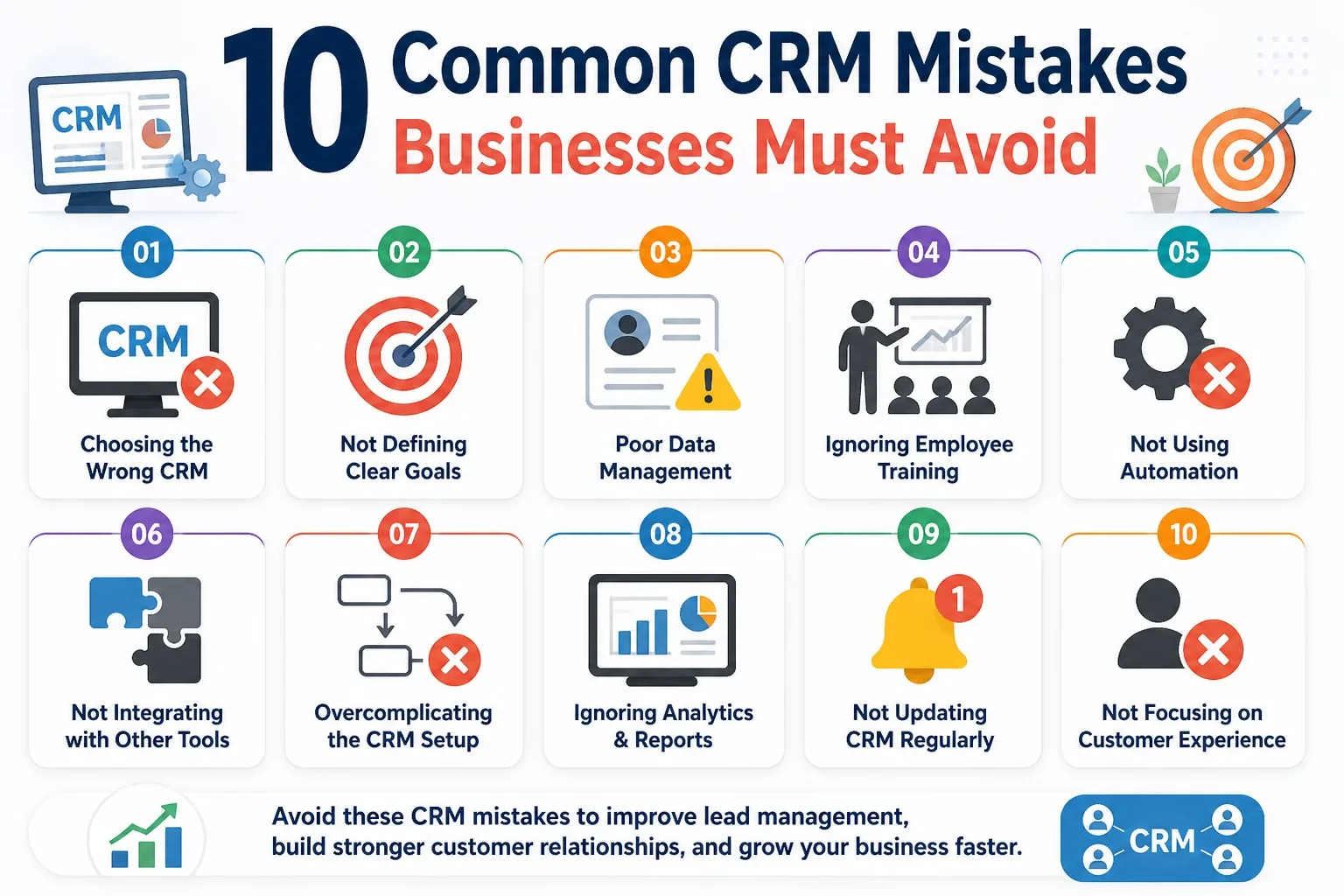
You invest in a CRM system expecting improved sales, better customer data management, and higher lead conversions. However, many businesses fail to see results from their CRM software. Leads get lost in the pipeline, teams avoid using the system, and CRM reports fail to deliver accurate insights. This challenge is more common than you might think.
The real issue is not the CRM software itself, but how businesses implement and use their Customer Relationship Management (CRM) system. Without a clear CRM strategy, proper setup, and team adoption, your CRM becomes just another database instead of a powerful lead management and sales growth tool. To avoid this situation, it is important to understand the most common CRM mistakes that directly impact business growth and sales performance. Let’s start with one of the biggest and most critical errors.
1. Choosing the Wrong CRM Software
Choosing the wrong CRM software is one of the most common and costly mistakes businesses make. Many companies select a CRM based on price, brand popularity, or limited features without evaluating their actual business needs. As a result, the system fails to align with their sales process, team workflow, and lead management requirements. This mismatch creates confusion among team members, reduces user adoption, and limits the overall effectiveness of the Customer Relationship Management system. Instead of improving productivity, the CRM becomes difficult to use and fails to deliver meaningful results. To avoid this, businesses should clearly define their goals, identify required features such as automation, reporting, and integrations, and choose a CRM that fits their specific industry and growth strategy.
2. Not Defining Clear Goals
Not defining clear goals is a major reason why businesses fail to get results from their CRM system. Many companies implement CRM software without a clear understanding of what they want to achieve, such as improving lead conversion, tracking sales performance, or enhancing customer relationships. Without specific objectives, teams use the Customer Relationship Management system inconsistently, which leads to poor data usage, confusion, and weak decision making. A CRM without direction becomes just a data storage tool instead of a strategic asset for business growth. To avoid this mistake, businesses should set measurable goals like increasing lead conversion rates, reducing response time, and improving sales pipeline visibility, ensuring the CRM supports clear and actionable outcomes.
3. Poor Data Management
Poor data management can seriously impact the performance of your CRM system. When businesses store incomplete, duplicate, or outdated information in their CRM software, it becomes difficult to track leads, understand customer behavior, and make accurate decisions. Sales teams lose trust in the data, which reduces adoption and weakens the overall effectiveness of the Customer Relationship Management system. Instead of driving growth, the CRM creates confusion and inefficiency. To avoid this issue, businesses should maintain clean and structured data by standardizing data entry, removing duplicates regularly, and updating customer information consistently. Clean data ensures better insights, improved lead management, and stronger sales performance.
4. Lack of Employee Training
Lack of proper training prevents teams from using a CRM system effectively. Many businesses implement CRM software but fail to guide their employees on how to use its features, workflows, and automation tools. As a result, team members rely on guesswork, avoid the system, or use it inconsistently, which leads to poor data entry and missed opportunities. The Customer Relationship Management system then fails to deliver accurate insights and expected results. To overcome this issue, businesses should invest in regular training sessions, provide clear usage guidelines, and ensure every team member understands how to use the CRM for lead management, follow ups, and reporting. A well trained team increases adoption, improves efficiency, and drives better business outcomes.
5. Ignoring Automation Features
Ignoring automation features limits the true potential of your CRM system. Many businesses use their CRM software only for storing data and manual tracking, while powerful automation tools remain unused. This leads to missed follow ups, delayed responses, and increased workload for the sales team. Without automation, the Customer Relationship Management system fails to improve efficiency and scalability. Tasks such as lead assignment, follow up reminders, email campaigns, and pipeline updates should run automatically to save time and reduce human error. Businesses that actively use CRM automation can respond faster, nurture leads effectively, and significantly improve conversion rates.
6. Not Integrating CRM with Website
Not integrating your CRM system with your website can result in lost opportunities and slower response times. When your CRM software is not connected to website forms, landing pages, or chat tools, leads are often captured manually or delayed, which increases the risk of missed inquiries. This gap affects lead tracking, follow ups, and overall customer experience. A disconnected Customer Relationship Management system fails to provide real time data and reduces the efficiency of your sales process. To avoid this mistake, businesses should integrate their CRM with website forms, contact pages, and lead generation tools so that every inquiry is automatically captured, assigned, and followed up without delay.
7. Weak Follow-Up System
A weak follow up system can significantly reduce the effectiveness of your CRM system. Many businesses capture leads through their CRM software but fail to follow up consistently and on time. As a result, potential customers lose interest, move to competitors, or remain unconverted. Without a structured follow up process, the Customer Relationship Management system cannot support lead nurturing or sales growth. To fix this, businesses should create a clear follow up strategy with defined timelines, reminders, and automated alerts. Consistent and timely follow ups help build trust, improve engagement, and increase overall conversion rates.
8. Overcomplicating the CRM Setup
Overcomplicating the setup of a CRM system often creates more problems than it solves. Many businesses add too many fields, complex workflows, and unnecessary features in their CRM software, which makes it difficult for teams to use effectively. This complexity leads to confusion, slower adoption, and inconsistent data entry. Instead of improving efficiency, the Customer Relationship Management system becomes time consuming and frustrating for users. To avoid this mistake, businesses should keep the CRM setup simple and focused on essential processes such as lead tracking, follow ups, and reporting. A clean and user friendly structure improves adoption, accuracy, and overall productivity.
9. Ignoring Analytics & Reports
Ignoring analytics and reports prevents businesses from unlocking the full potential of their CRM system. Many companies use CRM software only for data entry and lead tracking but fail to analyze performance metrics and insights. Without proper reporting, it becomes difficult to understand lead sources, sales trends, and conversion rates. This limits decision making and slows business growth. A Customer Relationship Management system is designed to provide valuable data that can improve strategy and performance. Businesses should regularly review CRM reports, track key metrics, and use data driven insights to optimize their sales process, improve lead quality, and increase overall efficiency.
10. Not Updating CRM Regularly
Not updating your CRM system regularly can make it ineffective and unreliable. When businesses fail to update their CRM software with the latest customer interactions, lead status, and sales activities, the data quickly becomes outdated. This leads to poor decision making, missed opportunities, and inaccurate reporting. An outdated Customer Relationship Management system cannot support effective lead management or sales planning. To avoid this mistake, businesses should ensure that their team updates the CRM consistently after every interaction, maintains accurate records, and reviews data regularly. Keeping your CRM updated helps improve visibility, enhances customer relationships, and drives better business results.
Case Study: How CRM Mistakes Impact Business Growth
CRM mistakes directly affect your sales performance, customer relationships, and overall business growth. When your CRM system is not used properly, leads get missed, follow ups are delayed, and your team fails to convert opportunities into customers. Poor data quality and lack of insights from CRM software also result in wrong decisions and ineffective strategies.
| Business Type | Mistake Made | Result | Solution Implemented | Outcome |
| Real Estate Company | No follow-up system | Lost 40% leads | Automated reminders & pipeline tracking | 2X lead conversion |
| Manufacturing Firm | Poor data management | Duplicate & messy records | Data cleaning & structured entries | Better decision-making |
| Healthcare Clinic | No CRM integration | Missed patient inquiries | Website + CRM integration | 60% faster response time |
| Education Institute | Lack of training | Low CRM usage | Staff training sessions | Increased team productivity |
| Pharma Company | Ignored analytics | No sales insights | Dashboard & reporting setup | Improved sales strategy |
Benefits of Using CRM the Right Way
When you use your CRM system correctly, it directly improves your business performance in multiple ways:
- Increase Lead Conversion Rates
A well-managed CRM software ensures timely follow ups, proper lead tracking, and better nurturing, which helps convert more prospects into customers. - Improve Customer Relationships
With organized customer data and interaction history, your Customer Relationship Management system helps you understand customer needs and build stronger, long-term relationships. - Save Time with Automation
CRM automation handles repetitive tasks like follow ups, reminders, and email workflows, allowing your team to focus on high-value sales activities. - Make Data-Driven Decisions
Accurate reports and analytics from your CRM provide valuable insights, helping you make smarter and more effective business decisions. - Scale Your Business Faster
An optimized CRM streamlines processes, improves efficiency, and supports growth by managing increasing leads and customers without chaos.
Frequently Asked Question
Q1. What are common CRM mistakes businesses make?
Common CRM mistakes include choosing the wrong CRM software, not defining clear goals, poor data management, lack of employee training, and ignoring automation and analytics features.
Q2. Why do CRM systems fail in businesses?
CRM systems fail when businesses do not have a proper CRM strategy, fail to train their team, or do not use the system consistently for lead management and follow ups.
Q3. How can businesses avoid CRM implementation mistakes?
Businesses can avoid CRM mistakes by setting clear goals, choosing the right CRM system, training employees, maintaining clean data, and using automation and reporting features effectively.
Q4. What is the biggest mistake in CRM usage?
The biggest mistake is not using the CRM strategically. Many businesses treat CRM software as a data storage tool instead of a system for lead generation and sales growth.
Q5. How does CRM improve lead management?
A CRM system helps track leads, automate follow ups, and organize customer data, making it easier to manage and convert leads efficiently.