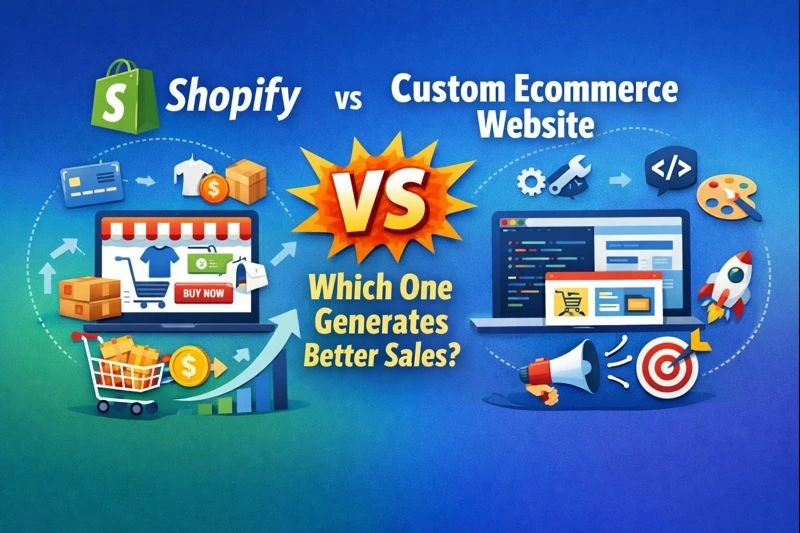
When businesses plan to launch or upgrade an ecommerce website, the most common question is not about design or technology, it’s about sales. Between Shopify and a custom ecommerce website, which one actually converts better, scales faster, and drives long-term revenue?
The answer isn’t one-size-fits-all. Both platforms can generate strong sales, but the way they do it, the control you get, and the long-term impact on growth are very different. This article breaks it down clearly so you can choose the right path for your business.
Understanding Shopify and Custom Ecommerce Websites
Shopify is a hosted ecommerce platform designed for speed and simplicity. You pay a monthly fee, choose a theme, add products, and start selling quickly. Hosting, security, and core features are handled for you.
A custom ecommerce website is built from scratch (or semi-custom frameworks) based on your exact business requirements. Everything from checkout flow to integrations and performance is tailored specifically for your customers and sales process.
The key difference lies in ownership, flexibility, and scalability, which directly affects sales potential.
Shopify vs Custom Ecommerce Website: Sales & Growth Comparison
| Factor | Shopify | Custom Ecommerce Website |
|---|---|---|
| Speed to Launch | Very fast (days) | Slower (weeks to months) |
| Initial Sales Generation | Strong for quick sales | Moderate initially |
| Checkout Customization | Limited | Fully customizable |
| Conversion Optimization | Template & app dependent | Behavior-driven, fully optimized |
| Scalability | Limited by platform & apps | Highly scalable |
| Average Order Value (AOV) | Moderate | Higher with custom upsells & flows |
| Repeat Purchases | App-dependent | Strong with CRM & loyalty integrations |
| SEO Performance | Average | Strong long-term organic growth |
| High Traffic Handling | Can slow during spikes | Optimized servers handle traffic better |
| B2B & Complex Pricing | Limited, app-based | Fully supported |
| Monthly / Transaction Fees | Yes (subscription + app costs) | No platform fees |
| Long-Term Sales ROI | Decreases as costs rise | Improves as sales scale |
| Ownership & Control | Platform-controlled | Fully business-owned |
| Best For | Startups, D2C, quick validation | Growing & enterprise businesses |
How Shopify Helps Generate Sales Quickly
Shopify is excellent for businesses that want to start selling fast with minimal technical effort. Its strength lies in ease of use and a proven ecosystem.
Shopify helps sales through:
1. Fast Store Launch and Ready-Made Checkout
Shopify allows businesses to launch an online store quickly with pre-built templates and a secure, optimized checkout system—reducing development time and helping you start selling faster.
2. Mobile-Friendly Themes Optimized for Basic Conversions
Most Shopify themes are responsive and designed for mobile users, ensuring smooth browsing, easy navigation, and faster checkouts, which helps improve basic conversion rates.
3. Built-In Payment Gateways and Cart Recovery
Shopify supports multiple payment options and includes abandoned cart recovery features, making it easier for customers to complete purchases and for businesses to recover lost sales.
4. Large App Ecosystem for Marketing and Upselling
Shopify’s extensive app marketplace offers tools for email marketing, upselling, cross-selling, reviews, and analytics—helping store owners boost average order value and customer engagement with minimal setup.
For startups, D2C brands, and small catalogs, Shopify often converts well because friction is low. Customers trust the platform, checkout is familiar, and setup errors are rare. However, as traffic and complexity increase, sales growth may start depending heavily on paid apps, higher monthly costs, and platform limitations.
How Custom Ecommerce Websites Drive Higher Long-Term Sales
Custom ecommerce websites focus on tailored user experience, which is critical for conversion optimization at scale.
A custom platform improves sales by:
- Designing checkout and product journeys based on user behavior
- Reducing unnecessary steps and distractions
- Integrating CRM, ERP, inventory, and marketing automation deeply
- Optimizing site speed and server performance for high traffic
- Creating unique features that competitors can’t easily copy
Custom websites allow businesses to fine-tune every conversion element from homepage storytelling to post-purchase upsells. This level of control often results in higher average order value and repeat purchases over time.
Shopify vs Custom Ecommerce: Sales Comparison
Shopify generally wins in short-term speed to revenue, while custom ecommerce wins in long-term scalability and profitability.
Shopify works best when:
- Product range is limited or medium
- Sales depend on ads and social traffic
- Standard checkout flow is sufficient
- Budget and timeline are tight
Custom ecommerce performs better when:
- Business requires unique buying logic
- B2B pricing, bulk orders, or subscriptions are involved
- SEO and organic sales matter long-term
- Brand experience is a major sales driver
Sales is not just about traffic, it’s about how well the website adapts to customer behavior. Custom platforms simply offer more room for optimization.
Cost vs Sales ROI Perspective
Shopify looks affordable initially but can become expensive as sales grow due to:
1. Monthly Subscription Fees
Shopify plans start at a reasonable price, but as your business scales, you often need higher-tier plans for advanced reporting, lower transaction fees, or staff accounts—raising monthly costs steadily.
2. Transaction Charges
If you don’t use Shopify Payments, Shopify charges additional transaction fees on every sale. As order volume increases, these small percentages turn into significant expenses.
3. Paid Apps for Features
Many essential features like advanced SEO, custom checkout rules, upsells, or automation require third-party apps. Most apps run on monthly subscriptions, increasing overall operational costs.
4. App Conflicts Affecting Performance
Installing multiple apps can cause compatibility issues, slow page load times, and checkout glitches. This not only affects user experience but may also require extra developer time to fix issues, adding hidden costs.
Custom ecommerce requires higher upfront investment but often results in:
- Lower long-term operational cost
- No per-transaction platform fees
- Better performance at scale
- Higher lifetime value per customer
From a sales ROI perspective, custom ecommerce usually outperforms Shopify after the business crosses a certain revenue threshold.
Case Study: Shopify to Custom Ecommerce Migration
A mid-sized Indian fashion brand started with Shopify and achieved decent traction through Instagram ads. Monthly revenue was steady, but growth plateaued.
Key issues they faced:
- Limited checkout customization
- Heavy reliance on paid apps
- Slow site speed during traffic spikes
- Poor organic SEO performance
After migrating to a custom ecommerce website:
- Checkout steps were reduced and optimized
- Page speed improved significantly
- SEO traffic increased within 4 months
- Average order value increased by 28%
- Repeat purchase rate improved by 35%
The brand didn’t just sell more, it sold smarter. This shift turned marketing spend into long-term growth instead of recurring platform costs.
Which One Generates Better Sales?
The honest answer is this:
Shopify generates sales faster, but custom ecommerce generates sales better over time.
If your goal is quick validation or short-term selling, Shopify is effective. If your goal is brand growth, higher margins, and scalable revenue, a custom ecommerce website provides stronger sales foundations.
Many growing businesses start with Shopify and later move to custom solutions once sales, traffic, and operational complexity increase.
FAQs
1. Is Shopify good for beginners?
Yes. Shopify is ideal for beginners due to its ease of use, ready features, and low technical involvement.
2. Can a custom ecommerce website convert better than Shopify?
Yes. Custom ecommerce sites often convert better because user experience and checkout flows are tailored to customer behavior.
3. Which platform is better for high traffic?
Custom ecommerce websites handle high traffic more efficiently with optimized servers and architecture.
4. Does Shopify limit sales growth?
Shopify doesn’t limit sales directly, but platform restrictions and rising app costs can affect scalability.
5. Which is better for SEO-driven sales?
Custom ecommerce websites perform better for long-term SEO and organic traffic growth.
6. Is custom ecommerce expensive?
Initial development cost is higher, but long-term ROI is usually better than recurring Shopify expenses.
7. Can Shopify handle B2B ecommerce?
Shopify can support basic B2B, but complex pricing, bulk orders, and workflows require heavy customization or apps.
8. When should a business move from Shopify to custom ecommerce?
When monthly revenue grows, conversion optimization becomes critical, and platform limitations affect growth.
9. Which option is best for Indian businesses?
For startups, Shopify works well. For growing and enterprise-level Indian businesses, custom ecommerce is more sales-efficient.
Final Thoughts
Choosing between Shopify and a custom ecommerce website should be a business decision, not a technical one. Shopify helps you start selling fast, but custom ecommerce helps you build a scalable, sales-focused ecosystem.
If your goal is serious growth, better margins, and long-term brand value, investing in a custom ecommerce website often delivers stronger sales results. Companies like Pointer Soft Technologies help businesses evaluate this transition carefully ensuring the ecommerce platform aligns with revenue goals, not just convenience.