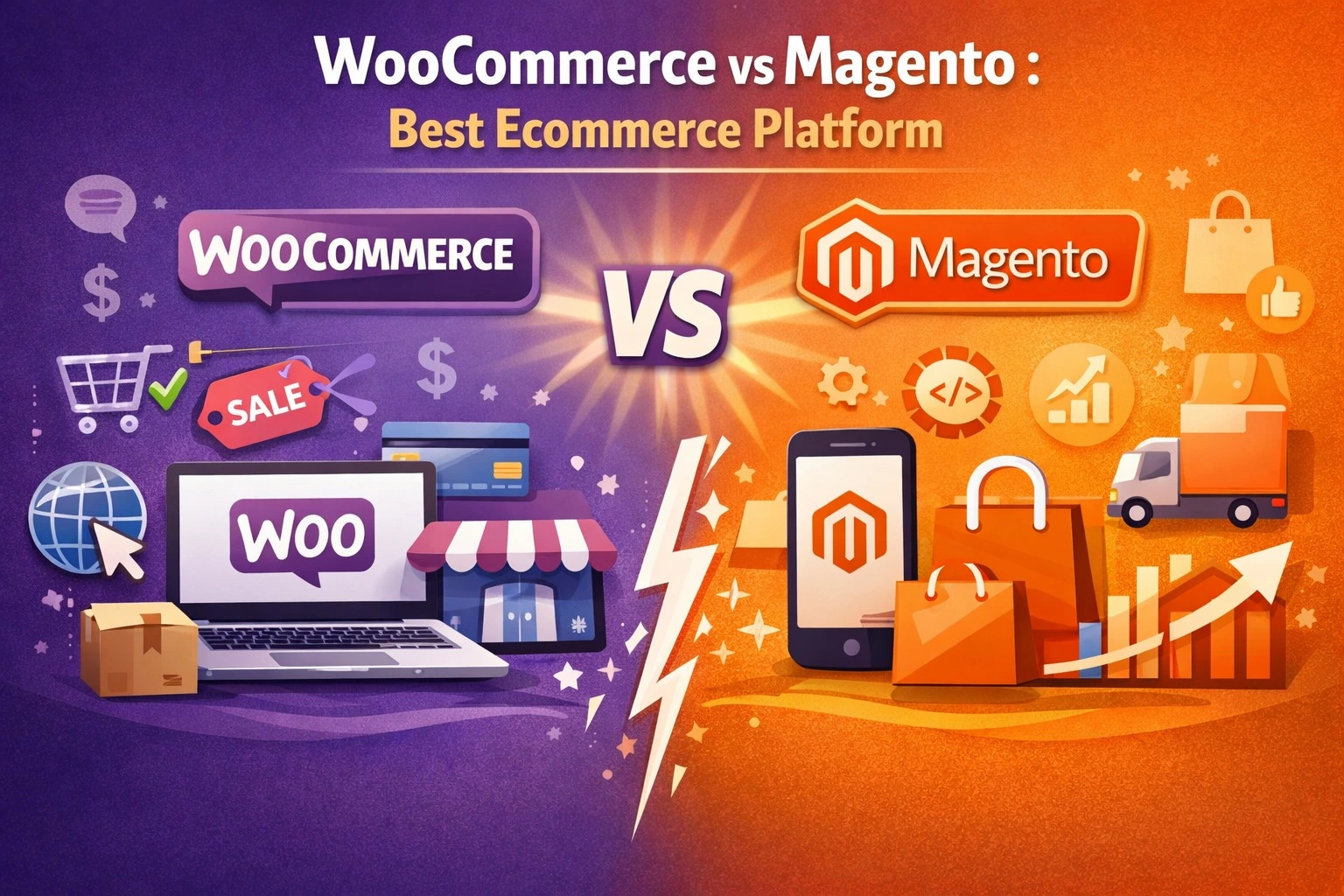
Running a small business is already demanding tight budgets, limited teams, and constant pressure to grow. Choosing the wrong eCommerce platform can quietly drain money, slow operations, and block future growth. Many small business owners face the same dilemma: WooCommerce or Magento? Both are powerful, but they serve very different business realities. This detailed comparison breaks down costs, performance, scalability, and real-world use so you can make a confident decision.
Understanding the Platforms at a Glance
WooCommerce is a WordPress-based eCommerce solution designed for simplicity and flexibility. It’s popular among startups and small businesses because of its low entry cost and ease of use.
Magento (now Adobe Commerce) is a robust enterprise-grade platform built for large catalogs, complex operations, and high traffic. While powerful, it demands higher investment and technical expertise. The key question is not “which is better overall,” but which is better for small businesses.
Cost Comparison: What You Pay vs What You Get
For small businesses, cost is often the first deciding factor. Here’s a realistic comparison:
| Factor | WooCommerce | Magento (Open Source) |
| Platform Cost | Free | Free |
| Hosting | ₹500–₹3,000/month | ₹8,000–₹25,000/month |
| Development | Low to moderate | High |
| Maintenance | Affordable | Expensive |
| Plugins/Extensions | Mostly low-cost | Often premium |
| Total First-Year Cost (Avg) | Low | High |
WooCommerce clearly wins on affordability. Magento may be free on paper, but hosting, development, and maintenance costs add up quickly often beyond what small businesses expect.
Ease of Use & Management
WooCommerce is beginner-friendly. Product uploads, content updates, and order management can be handled without technical expertise. Most small business owners manage daily tasks themselves.
Magento, on the other hand, requires developer involvement for even minor changes. Its backend is powerful but complex, making it less suitable for non-technical teams. For small businesses with limited resources, ease of use directly impacts productivity and cost control.
Performance & Speed Considerations
Performance affects both SEO and conversions.
WooCommerce performs well for small to medium stores when paired with good hosting and optimization. Page speed, caching, and SEO plugins are easy to implement.
Magento is built for high traffic and large catalogs. However, without strong servers and optimization, Magento sites can feel heavy and slow especially for small stores that don’t need enterprise-level architecture.
In short:
- Small catalog + moderate traffic → WooCommerce handles it efficiently
- Massive catalog + enterprise traffic → Magento makes sense
Scalability: Growing with Your Business
Magento is often marketed as “more scalable,” and that’s true but scalability comes at a cost. Scaling Magento requires better servers, ongoing development, and higher maintenance budgets.
WooCommerce scales differently. It allows small businesses to grow gradually adding features, payment options, and integrations only when needed. Many successful mid-sized stores still run efficiently on WooCommerce.
For small businesses, controlled scalability is often more practical than enterprise-level complexity.
SEO & Marketing Capabilities
WooCommerce has a major advantage here due to its WordPress foundation. Content marketing, blogging, on-page SEO, and schema optimization are straightforward.
Magento has strong SEO features, but they often require configuration and technical knowledge. For small teams without SEO specialists, WooCommerce offers faster results with less effort. If organic traffic is a growth channel for your business, WooCommerce aligns better with content-driven SEO strategies.
Real Case Study: Local Retailer’s Platform Switch
A mid-sized local fashion retailer started with Magento, expecting rapid growth. Within a year, they faced high hosting bills, frequent developer dependency, and slow updates. Managing seasonal offers became costly and time-consuming. They migrated to WooCommerce with a focus on performance optimization and SEO. Results within 6 months:
- Website maintenance cost reduced by 45%
- Page load speed improved significantly
- Organic traffic increased through blog-led SEO
- Team gained control over daily updates without developers
For their business size, WooCommerce proved to be the more sustainable choice.
When Magento Actually Makes Sense
Magento is not a bad platform—it’s just often overkill for small businesses. It makes sense if:
- You have thousands of products
- You manage multiple stores from one backend
- You have an in-house technical team
- Budget is not a constraint
If these don’t describe your current stage, WooCommerce is usually the smarter option.
FAQs
1. Is WooCommerce good enough for professional eCommerce?
Yes. With the right design, hosting, and optimization, WooCommerce powers highly professional and profitable stores.
2. Is Magento free for small businesses?
Magento Open Source is free, but real-world costs (hosting, development, maintenance) make it expensive for small businesses.
3. Which platform is better for SEO?
WooCommerce, due to WordPress integration, is generally easier and faster for SEO-focused growth.
4. Can WooCommerce handle high traffic?
Yes, with proper hosting and caching, WooCommerce can handle significant traffic for small and mid-sized stores.
5. Is Magento hard to maintain?
Magento requires technical expertise and regular maintenance, which can be challenging for small teams.
6. Which platform offers better ROI for small businesses?
WooCommerce usually delivers better ROI due to lower costs and faster marketing execution.
7. Can I migrate from WooCommerce to Magento later?
Yes. Many businesses start with WooCommerce and migrate later if enterprise needs arise.
8. Which platform is faster to launch?
WooCommerce allows faster deployment and quicker go-to-market.
Final Thought
For most small businesses, WooCommerce is the better eCommerce platform. It strikes the right balance between cost, performance, ease of use, and long-term growth without overwhelming budgets or internal teams. Magento is undeniably powerful, but its strengths are best suited to large enterprises with complex operations rather than lean businesses focused on ROI and agility.
If your goal is sustainable growth, predictable costs, and marketing flexibility, WooCommerce aligns far better with small business realities. This is exactly where the right implementation matters. Agencies such as Pointer Soft Technologies, help small businesses design, optimize, and scale WooCommerce stores that are not just functional but conversion-focused, SEO-ready, and built for measurable growth. The platform is important, but how it’s executed makes the real difference.