As businesses grow, their website often becomes a bottleneck instead of a growth driver. Traffic starts coming in through SEO, ads, referrals, or social media, but enquiries and conversions do not scale at the same pace. This usually triggers an important question for decision-makers: should we redesign the website or optimize the existing one?
While both options sound similar, they solve very different problems. Choosing the wrong approach can waste time, budget, and momentum. Understanding what your business actually needs is critical for sustainable growth.
Understanding Website Redesign
A website redesign focuses on rebuilding the visual appearance, layout, and sometimes the technology stack of a website. Businesses usually consider redesign when the site looks outdated, branding has changed, or the user interface feels visually unappealing.
Redesigns typically address surface-level issues such as modern layouts, updated colors, new fonts, or refreshed imagery. In some cases, they also involve migrating to a new CMS or restructuring navigation.
However, redesign alone does not guarantee better results. Many growing businesses invest in visually impressive websites only to realise that enquiries remain flat because the underlying conversion issues remain untouched.
Understanding Website Optimization
Website optimization focuses on improving how an existing website performs. The goal is not to make the site look new, but to make it work better.
Optimization looks closely at user behaviour, intent, and friction points. It improves messaging clarity, page structure, CTAs, forms, load speed, mobile usability, and trust elements. The emphasis remains on conversions, not aesthetics.
For growing businesses with steady traffic, optimization often delivers faster and more measurable results than a full redesign.
Key Differences Between Redesign and Optimization
The table below highlights how both approaches differ in purpose and outcome:
| Aspect | Website Redesign | Website Optimization |
| Primary focus | Visual refresh and layout | Performance and conversions |
| Trigger point | Outdated design or rebranding | Low leads despite traffic |
| Time required | High | Moderate |
| Cost impact | Higher | More cost-effective |
| Risk factor | Can disrupt existing performance | Improves existing strengths |
| Conversion impact | Uncertain | Measurable and data-driven |
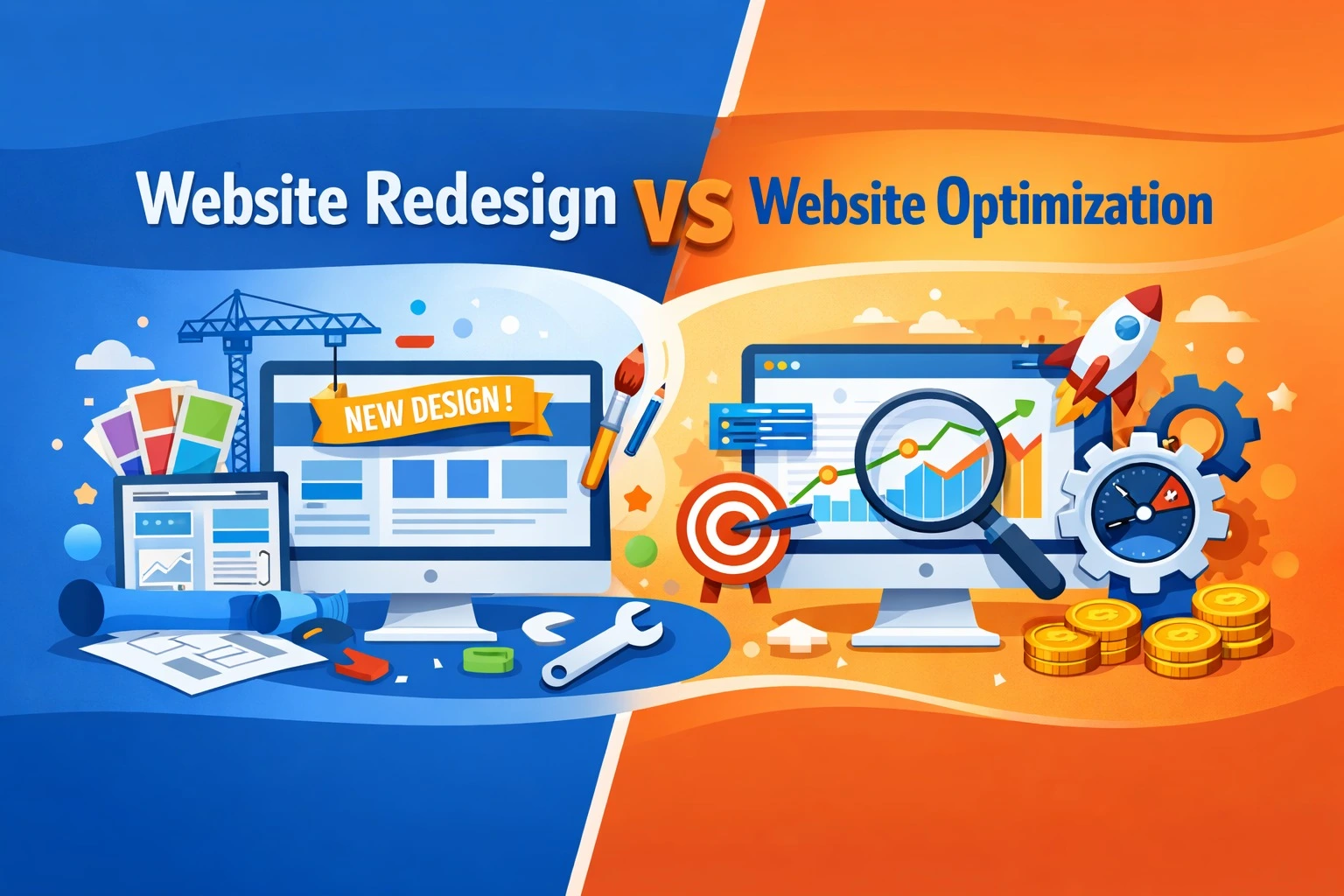
This comparison makes one thing clear. Redesign changes how your website looks. Optimization changes how your website performs.
What Growing Businesses Actually Struggle With
Most growing businesses already have traffic. They appear on Google, run ads, or get referrals. The real struggle lies in converting that attention into qualified leads.
Common symptoms include high bounce rates, low enquiry form submissions, short session durations, and inconsistent lead quality. These are not design problems. They are conversion problems. In such cases, redesigning the website without addressing messaging, structure, and user intent often leads to disappointment.
Real Case Study: Redesign vs Optimization in Action
A mid-sized B2B services company in India was generating consistent traffic through Google Ads and organic search. Despite this, the number of monthly enquiries remained stagnant. The management team initially believed that the website needed a complete redesign to improve results.
Before proceeding, a detailed website performance audit was conducted to identify the real issue.
Key Challenges Identified
The audit revealed that the website design was not the main problem. Instead, the site struggled with several conversion-related issues:
- The homepage did not clearly communicate the business value or outcomes
- Service pages focused heavily on features rather than customer problems and solutions
- Enquiry forms were long and discouraged users from completing them
- Trust elements such as testimonials and client logos were poorly positioned
- Mobile performance and page load speed needed improvement
Strategy Chosen: Website Optimization Over Redesign
Rather than rebuilding the entire website, the business opted for focused website optimization to improve performance while retaining the existing structure.
The optimization efforts included:
- Rewriting homepage messaging to highlight outcomes and business benefits
- Restructuring service pages using a problem–solution–proof framework
- Reducing enquiry forms from eight fields to four to lower friction
- Placing testimonials and client logos near key call-to-action sections
- Improving mobile responsiveness and overall page speed
Results Achieved Within Three Months
Without increasing ad spend or traffic volume, the business experienced measurable improvements:
- 41 percent increase in average session duration
- Significant reduction in bounce rate
- 2.3x growth in qualified enquiries
- More consistent lead quality across channels
Key Insight
This case study shows that growing businesses often do not need a full website redesign. When traffic already exists, optimizing clarity, structure, and user experience can deliver faster ROI and stronger conversion growth than starting from scratch.
When a Redesign Makes Sense
Website redesign is the right choice when the foundation itself is weak. This includes situations where the website is technically outdated, not mobile-friendly at all, or completely misaligned with the current brand positioning.
Redesign also becomes necessary after major business pivots, mergers, or shifts in target audience where the existing structure no longer supports new goals. In these cases, redesign should still follow a conversion-first strategy rather than a purely visual approach.
When Optimization Is the Smarter Move
Website optimization is ideal when traffic exists but results do not. If users visit your site but do not enquire, optimization delivers faster and safer improvements.
It allows businesses to test, measure, and improve without risking current SEO rankings or user familiarity. For growing businesses, this approach often aligns better with performance goals and budget efficiency.
Final Thought
Growing businesses do not need constant redesigns. They need clarity, performance, and predictable conversions. While redesign changes appearance, optimization drives growth. The smartest approach is not choosing one blindly, but understanding what problem you are solving.
At agencies like Pointer Soft Technologies, website decisions are guided by data, real user behaviour, and clear business goals rather than assumptions. The focus stays on understanding what will genuinely improve performance. Whether a business requires targeted optimization or a carefully planned redesign, the objective remains consistent: helping existing traffic convert into reliable, high-quality enquiries that support long-term growth.
For growing businesses, the right website strategy is not about looking new. It is about working better.
Frequently Asked Questions
Is website optimization cheaper than redesign?
Yes. Optimization usually costs less and delivers faster results because it builds on the existing website instead of rebuilding everything.
Can optimization be done without affecting SEO?
When done correctly, optimization improves SEO by enhancing user experience, engagement, and page performance.
How long does website optimization take to show results?
Most businesses see noticeable improvements within one to three months, depending on traffic volume.
Should I redesign first and then optimize?
Only if the current website is technically outdated or structurally broken. Otherwise, optimization should come first.
How do I know what my website needs?
A professional website audit that reviews traffic, behaviour, conversions, and technical health provides the clearest answer.