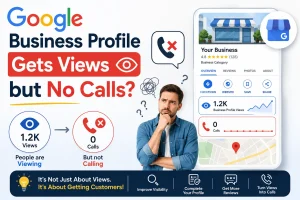
Local businesses spend time and money on digital marketing but still struggle with one core problem. Leads remain inconsistent. Some days the phone rings. Some days nothing happens. Many business owners feel confused because they appear on Google but enquiries do not grow. This gap between visibility and results creates frustration. The biggest reason behind this problem is not marketing effort. It is choosing the wrong primary channel.
Most local businesses reach a point where they must decide whether to rely on Google My Business or invest in a professional website. Both help with online presence, but they generate leads in very different ways. Understanding this difference helps businesses build a predictable and scalable lead system instead of depending on luck. This blog breaks down Google My Business (GMB) vs Website from a lead-generation perspective, not just visibility.
Understanding Google My Business as a Lead Source
Google My Business helps businesses appear in local search results, Google Maps, and the “local pack.” When someone searches “website designer near me” or “packers and movers in Gurgaon,” GMB listings show up first. GMB generates leads mainly through:
Phone calls
Google My Business allows users to call directly from search results or Google Maps. These calls usually come from high intent users who want immediate information such as pricing, availability, or location. Phone calls work well for urgent services but often focus on quick decisions rather than detailed evaluation.
Direction Requests
Direction requests indicate strong local intent. Users searching for directions usually plan to visit the business location or reach it physically. While this shows interest, it does not always translate into a confirmed enquiry, especially for service based businesses that operate remotely.
Basic Enquiries
Google My Business enables users to send short messages or enquiries directly from the listing. These enquiries remain limited in detail because the platform restricts content length and context. Businesses often receive generic questions that require follow up for qualification.
Website Visits
When a website link exists on the GMB profile, users click through to learn more before making a decision. These visitors show higher intent because they want clarity and trust. A well structured website converts this traffic into quality leads, while a weak website causes drop offs.
Understanding a Website as a Lead-Generation Asset
A website acts as your owned digital property. Unlike GMB, you control the content, design, user journey, and conversion flow. A well-structured website generates leads through:
Contact Forms
Contact forms allow visitors to share their requirements without pressure. They capture structured information such as service type, location, and contact details. This helps businesses qualify leads and respond with context instead of generic follow ups.
Call to Action Buttons
Call to action buttons guide visitors toward a specific action such as requesting a quote or booking a call. Clear and visible CTAs reduce confusion and increase conversions by telling users exactly what to do next.
Service Pages
Service pages target users searching for specific solutions. These pages explain offerings in detail, answer common questions, and align with local keywords. Well optimized service pages attract high intent visitors and convert them into enquiries.
Landing Pages
Landing pages focus on one goal. They remove distractions and highlight a single service or offer. Businesses use landing pages for local campaigns, ads, or city based targeting to generate focused and measurable leads.
Trust Elements
Trust elements such as testimonials, case studies, and certifications reduce hesitation. They show real proof of experience and results. When visitors see social validation, they feel confident taking the next step and contacting the business.
Google My Business vs Website: Lead Generation Comparison
| Factor | Google My Business | Website |
| Ownership | Google controls the platform | You fully own it |
| Visibility | Strong for “near me” searches | Strong for branded & service searches |
| Conversion Depth | Limited | High |
| Trust Building | Reviews only | Reviews + content + design |
| Lead Tracking | Basic insights | Advanced analytics |
| Scalability | Limited | Highly scalable |
| Long-Term Value | Medium | High |
This comparison shows why relying on only one channel creates gaps in lead generation.
Where Google My Business Wins
GMB works exceptionally well when users want quick answers. People searching on mobile often want immediate solutions. Google My Business performs best when:
The business depends on calls
Google My Business works well for businesses where phone calls drive most conversions. Users can call directly from search results, which reduces friction and speeds up decision making. This suits service models that close leads over the phone.
Services are urgent
Urgent services benefit the most from Google My Business visibility. When users face immediate needs such as repairs, relocation, or medical assistance, they choose nearby options quickly. GMB captures this urgency by showing businesses at the exact moment of need.
Location matters more than branding
For businesses where proximity influences choice, Google My Business delivers strong results. Users often select services based on distance rather than brand perception. GMB highlights location, ratings, and availability, which aligns with this behavior.
Competition is moderate
Google My Business performs better in areas with manageable competition. When fewer businesses compete for the same category, listings gain higher visibility and engagement. In highly competitive markets, GMB alone may not generate consistent leads.
Where Websites Win for Local Leads
A website takes over once the user wants clarity, confidence, and comparison. Most serious buyers still visit a website before making a decision. Websites outperform GMB when:
Services involve higher cost
When services require higher investment, customers take more time before deciding. They look for detailed information, clear pricing logic, and proof of expertise. A website supports this evaluation by explaining value, process, and outcomes in depth.
Trust plays a big role
Customers hesitate when trust feels unclear. A website builds confidence through structured content, testimonials, case studies, and professional design. This reassurance often determines whether a visitor converts into a serious enquiry.
Customers compare multiple vendors
Most buyers do not choose the first option they see. They compare service offerings, experience, reviews, and credibility across multiple providers. A website helps businesses stand out by presenting clear differentiation and authority.
Long term branding matters
Businesses that plan for sustainable growth need consistent branding. A website establishes brand identity, messaging, and positioning over time. Unlike third party platforms, it strengthens recognition and recall with every visit.
Real Case Study: Local Service Business in India
A local packers and movers company in Gurgaon relied only on Google My Business for lead generation. They received around 40–45 calls per month, mostly price-focused enquiries.
The Problem
- Low-quality leads
- High call drop rate
- No brand differentiation
- No way to retarget visitors
The Solution
The business launched a conversion-focused website with:
- Service pages for each location
- Clear pricing explanation
- Trust badges and testimonials
- Direct CTA buttons linked with GMB
The Result (within 4 months)
| Metric | Before Website | After Website |
| Monthly Leads | 40–45 | 110–130 |
| Conversion Rate | ~6% | ~18% |
| Lead Quality | Low | High |
| Repeat Enquiries | Rare | Frequent |
Google My Business continued to bring traffic, but the website turned that traffic into serious leads.
The Best Strategy: GMB + Website Together
The real question is not GMB vs Website, but how they work together. The highest-performing local businesses:
Use GMB for discovery
High performing local businesses use Google My Business to appear at the exact moment customers search for nearby services. GMB increases visibility in local results and Google Maps, helping potential customers discover the business quickly.
Send traffic to a high converting website
These businesses direct GMB visitors to a well structured website. The website explains services, answers common questions, and guides users toward action, turning casual visitors into serious enquiries.
Capture leads through structured forms
Structured forms help businesses collect relevant details such as service type, location, and urgency. This approach improves lead quality and allows faster and more effective follow up.
Build long term authority via content
Content such as blogs, service pages, and case studies builds expertise and trust over time. Consistent content strengthens brand authority and improves search visibility, leading to sustainable lead generation.
FAQ Section
Is Google My Business enough without a website?
Google My Business helps with visibility, but it cannot fully convert users. A website improves trust, explains services, and captures high-quality leads.
Do small local businesses really need a website?
Yes. Even small businesses benefit from a website because customers compare options before choosing. A website builds credibility instantly.
Which gives faster results: GMB or a website?
GMB gives faster visibility, while a website delivers better long-term lead quality and scalability.
Can a website rank locally without Google My Business?
Yes, but GMB improves local presence. Together, they dominate local search results.
How does a website increase GMB leads?
A website converts GMB visitors by answering doubts, showing proof, and guiding users to take action.
Final Verdict: Which Generates More Local Leads?
Google My Business plays an important role in attracting local attention. It helps potential customers discover your business when they search nearby. However, discovery alone does not guarantee growth. A website completes the journey. It answers questions, builds trust, and guides visitors toward meaningful action. Businesses that rely only on Google My Business often experience irregular enquiries and limited scalability. In contrast, businesses that combine Google My Business with a conversion focused website create a stable and predictable local lead system.
Real business growth comes from ownership and control. A website gives businesses the ability to shape messaging, improve user experience, track performance, and build long term authority. Without it, growth remains dependent on external platforms and changing algorithms. Teams at companies like Pointer Soft Technologies focus on designing websites that complement Google My Business rather than compete with it. The emphasis stays on clarity, user experience, and conversion flow so that local search visibility translates into real business outcomes.
For businesses planning long term growth, a website is more than an online presence. It acts as the foundation that supports discovery, trust, and consistent lead generation.