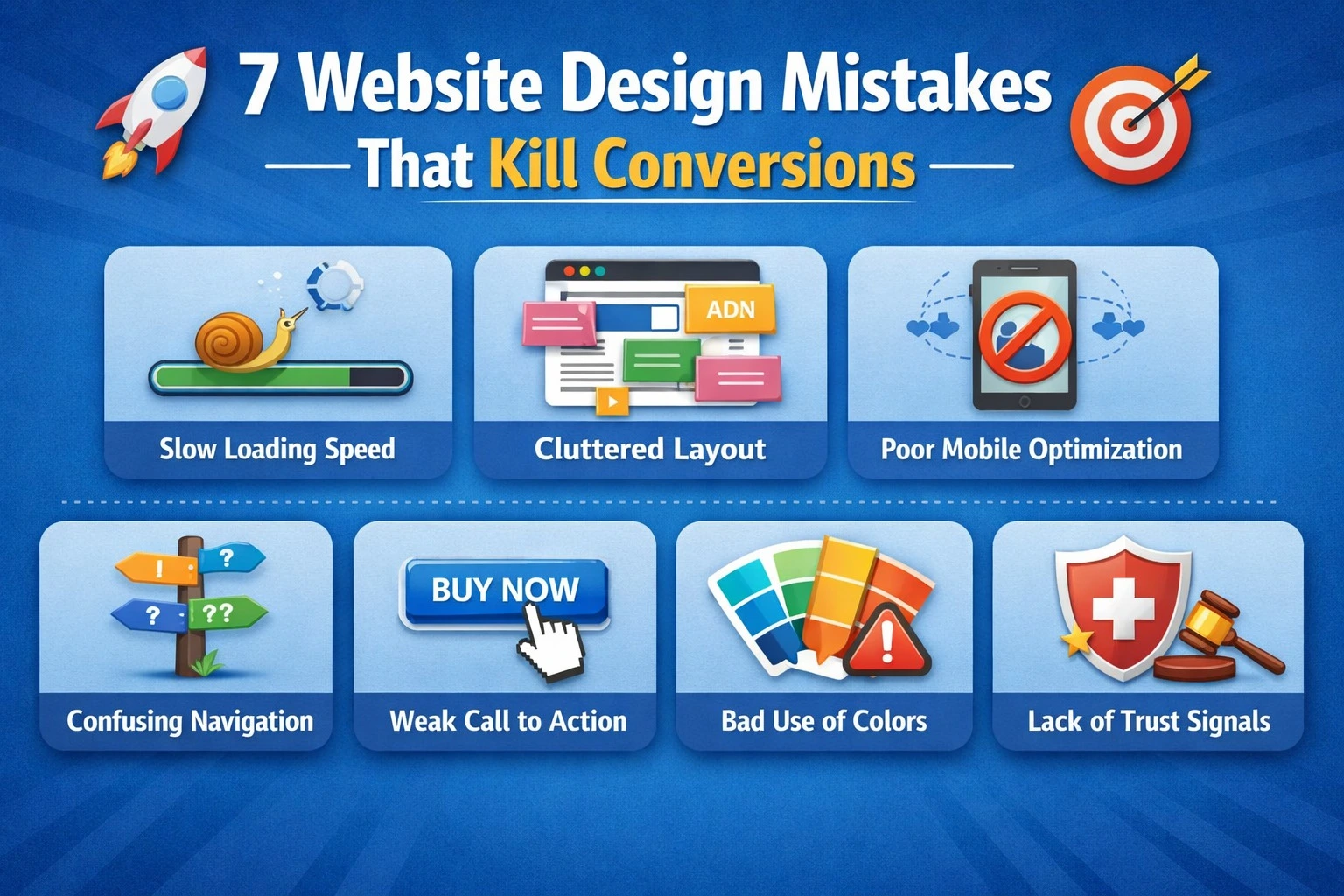
For many Indian businesses, a website acts as the main source of enquiries and sales. Yet a large number of websites fail to convert visitors into customers. The problem is rarely traffic. In most cases, poor website design silently blocks conversions.
Website design is not only about appearance. It directly affects trust, usability, and decision making. Indian users are highly mobile driven, value conscious, and quick to judge credibility. Even small design mistakes can push potential customers away. This blog explains the most damaging website design mistakes Indian businesses make and how each one negatively impacts conversions.
Why Website Design Plays a Critical Role in Conversions
When a visitor lands on a website, they subconsciously decide within seconds whether to stay or leave. Design shapes that decision. A clear layout builds confidence. A confusing layout creates doubt.
A conversion focused website guides users smoothly from interest to action. A poorly designed website forces users to think and hesitation kills conversions.
1. Unclear Homepage Messaging
The homepage is the most important page of any business website. For many Indian businesses, it is the first and sometimes the only chance to make an impression. When homepage messaging is unclear, visitors leave without taking any action, no matter how good the service actually is.
Unclear messaging means the visitor cannot quickly understand what the business offers, who it is meant for, and why they should choose it. Indian users scan websites very quickly. They do not read word by word. If clarity is missing in the first few seconds, trust drops and bounce rate increases.
2. Ignoring Mobile First Design
Ignoring mobile first design is one of the biggest reasons Indian business websites fail to convert. Today, the majority of users in India access websites through smartphones, not desktops. When a website is designed mainly for desktop users, it creates friction for mobile visitors, and friction kills conversions.
Mobile first design means designing the website primarily for mobile users and then scaling it up for larger screens. Many businesses do the opposite. They design for desktop first and later try to adjust the layout for mobile. This approach leads to poor usability and lost leads.
3. Slow Page Loading Speed
Slow page loading speed is one of the most damaging website design issues for Indian businesses. Even if a website looks visually appealing, users will not wait for it to load. Speed directly affects user experience, trust, and conversion rates.
In India, internet quality varies widely depending on location, network strength, and device. A website that loads slowly on average connections loses a large portion of potential customers before they even see the content.
4. Weak or Hidden Call to Action
A call to action is the bridge between a website visitor and a business conversion. Without a strong call to action, users may leave the website without taking any meaningful step, regardless of how good the content or design is. For Indian businesses, this is a very common problem that directly impacts lead generation and sales.
A weak call to action fails to communicate what the user should do next, while a hidden call to action is often buried in the page, making it difficult for visitors to notice. Both situations confuse the user and result in lost opportunities.
5. Visual Clutter and Overdesign
Visual clutter and overdesign are common mistakes that hurt conversions on Indian business websites. Many businesses try to make their websites look impressive by adding multiple design elements, colors, animations, and images. While it may appear attractive at first, overdesign overwhelms users and prevents them from focusing on the main goal of the website, which is to guide them toward taking action.
A clean and simple design does not mean the website is boring. Instead, it ensures that visitors can understand your message, navigate easily, and take action without distraction.
6. Missing Trust Signals
Trust signals are critical elements on a website that communicate credibility, reliability, and professionalism to visitors. For Indian businesses, missing trust signals is a common reason why potential customers leave without converting. Even if the website looks good and the content is strong, users hesitate to take action if they do not trust the business.
Trust signals reassure visitors that your company is genuine, experienced, and capable of delivering on its promises. Without them, conversions drop significantly.
7. Confusing Navigation Structure
Navigation is the roadmap of a website. It guides users to find the information they are looking for and ultimately take action. A confusing navigation structure is one of the most common design mistakes that kill conversions for Indian businesses. When visitors cannot find important pages or feel lost on a website, they leave immediately, no matter how good the service is.
Effective navigation ensures a smooth user journey, reduces frustration, and encourages visitors to engage with key conversion points such as enquiry forms, call buttons, or product pages.
Table Showing Design Mistakes and Their Impact
| Website Design Mistake | Effect on Conversions | Recommended Improvement |
|---|---|---|
| Unclear messaging | High bounce rate | Clear value proposition |
| Slow website | Visitor drop off | Speed optimization |
| Poor mobile design | Lost mobile leads | Mobile friendly layout |
| Weak call to action | Low enquiries | Strong action prompts |
| No trust signals | Low credibility | Display social proof |
How Indian Businesses Can Improve Website Conversions
1. Focus on User Intent
Every design decision should prioritize what the visitor wants to achieve. Indian users visit websites to solve a problem, get information, or make a purchase. By understanding their intent, you can guide them toward the right pages, content, and calls to action, improving engagement and conversions.
2. Design for Mobile Users First
Most Indian users access websites via smartphones. Designing for mobile first ensures your website loads fast, is easy to navigate, and has clickable buttons and readable text. This improves the user experience and increases the likelihood of enquiries and leads.
3. Keep Layouts Clean and Structured
A clean layout reduces visual clutter and makes it easier for users to focus on the most important elements. Structured pages guide visitors naturally from headlines to content to calls to action, helping them make decisions quickly without confusion.
4. Build Trust Through Transparency
Trust is a major factor for Indian users. Display client testimonials, case studies, certifications, contact information, and security features clearly. Transparent websites make users feel confident to share details, submit forms, or make purchases.
5. Track Performance and Optimize Regularly
Without monitoring user behavior, businesses cannot identify what works and what does not. Track metrics like page views, bounce rates, click rates, and form submissions. Use the insights to continuously improve design, content, and calls to action, ensuring higher conversions over time.
Frequently Asked Questions
Does website design really impact conversions
Yes. Design influences trust, usability, and user decisions which directly affect conversion rates.
How often should a website be redesigned
Businesses should review their website every two to three years or sooner if performance drops.
Is mobile optimization more important than desktop design
For Indian audiences, mobile optimization is critical due to higher smartphone usage.
Can conversion rates improve without a full redesign
Yes. Improving calls to action, speed, content clarity, and mobile experience can significantly boost conversions.
How long does it take to see results after design improvements
Most businesses notice positive changes within thirty to sixty days.
Final Thoughts
Every Indian business website has the potential to generate more leads, enquiries, and sales. However, simple design mistakes like unclear messaging, weak calls to action, slow loading speed, or missing trust signals often prevent this potential from being realized. Traffic alone does not guarantee conversions. The way your website guides users, builds trust, and delivers value determines whether visitors become customers.
At Pointer Soft Technologies, we specialize in designing websites that are not just visually appealing but strategically built to convert. By focusing on user intent, mobile-first design, clean layouts, and trust-building elements, we help Indian businesses turn their websites into powerful lead generation tools. Our data-driven approach ensures continuous optimization, so your website performs better over time.