Small businesses in 2026 struggle with one painful reality: leads are unpredictable, marketing costs keep rising, and every wrong decision eats directly into profit. Owners don’t lack effort they lack clarity. When budgets are tight, choosing the wrong marketing channel can mean months of wasted spend with nothing to show for it.
Most small businesses stand at the same crossroads. SEO (Search Engine Optimization) promises steady growth but demands patience. Google Ads promises instant visibility but charges for every click whether it converts or not. Both sound attractive. Both claim results. Yet only one aligns with how small businesses actually survive and scale.
This blog cuts through marketing noise and agency promises. It compares SEO vs Google Ads from a small business pain-point perspective, breaks down real costs, exposes ROI realities, and helps you choose a strategy that delivers consistent leads without draining your budget. No theory. No hype. Just what works when margins matter.
Understanding SEO and Google Ads Clearly
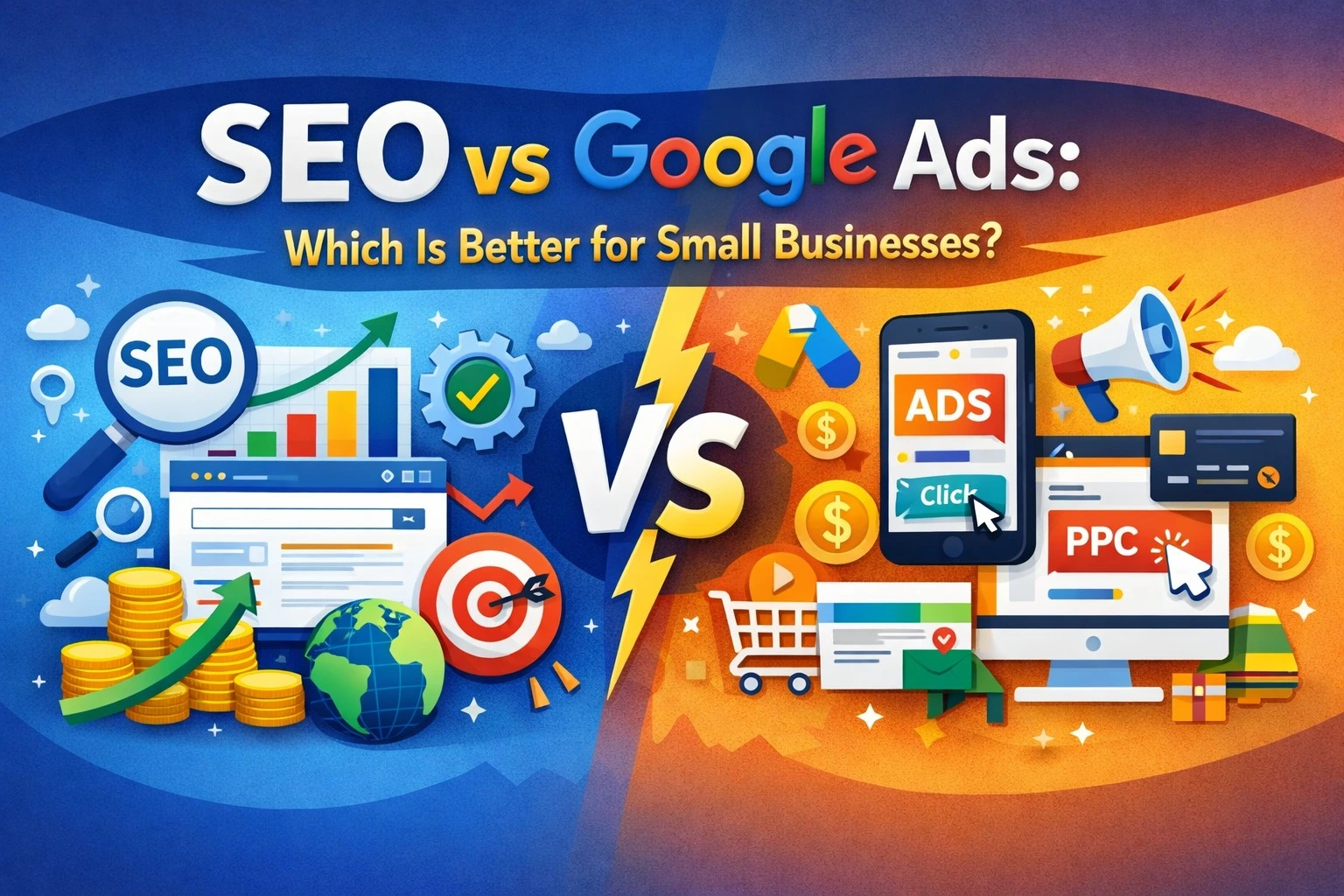
SEO and Google Ads solve the same problem getting visibility on Google but they do it in fundamentally different ways, and that difference matters deeply for small businesses.
SEO builds visibility you own. When you invest in SEO, you improve your website’s content, structure, speed, and authority so Google trusts it enough to rank it organically. Once your pages start ranking, they can bring traffic every day without paying for each visitor. This makes SEO a compounding asset. The longer you stay consistent, the stronger your visibility becomes, and the lower your cost per lead gets over time. Even if you reduce spending later, your rankings and traffic don’t disappear overnight.
Google Ads rents visibility. With Google Ads, you pay for placement at the top of search results. Your ad can appear within hours, which feels powerful especially when leads are urgently needed. However, every click costs money, whether that user converts or not. The moment you stop funding campaigns, traffic stops instantly. There is no residual benefit, no long-term buildup, and no protection against rising competition or increasing cost-per-click.
For small businesses, this difference is critical. SEO rewards patience and discipline with predictable, lower-cost leads and long-term stability. Google Ads rewards speed but demands continuous spending and constant optimization to stay profitable.
Both tools work but not equally for every business situation. Small businesses with limited budgets, long sales cycles, or local service offerings often gain more from SEO’s long-term impact. Google Ads works better as a short-term accelerator, not a foundation. Understanding this distinction prevents wasted spend and helps small businesses choose growth over short-lived visibility.
SEO vs Google Ads Cost & Performance Comparison (2026)
| Factor | SEO | Google Ads |
| Initial Cost | Moderate | Low to Moderate |
| Ongoing Cost | Low | High (per click) |
| Time to See Results | 3–6 months | Immediate |
| Cost per Lead (Avg.) | ₹300–₹700 | ₹1,200–₹3,500 |
| Traffic Sustainability | Long-term | Stops when ads stop |
| Trust & Credibility | High | Medium |
Real Case Study: Delhi-Based Small Service Business
Business Profile
- Industry: Website design & digital services
- Location: Delhi NCR
- Monthly marketing budget: ₹40,000
Strategy 1: Google Ads (First 3 Months)
The business invested the entire budget into Google Ads targeting keywords like website designing company in Delhi.
Results:
- Avg CPC: ₹85
- Monthly clicks: ~470
- Leads per month: 12–15
- Cost per lead: ~₹2,700
- Conversion quality: Medium
- Long-term value: Zero after ads stopped
Once the ads paused, traffic dropped to almost zero.
Strategy 2: SEO (Next 6 Months)
The same business shifted focus to SEO.
Actions taken:
- Local SEO optimization
- Service-based blog content
- Technical SEO fixes
- Google Business Profile optimization
Results after 6 months
After six months of consistent SEO implementation, the business achieved measurable and sustainable growth. Its website started ranking on the first page of Google for six high-intent commercial keywords, which significantly increased visibility among users actively searching for services. As a result, monthly organic traffic crossed 2,800 visits, driven by users with genuine buying intent rather than casual browsers. This steady traffic translated into 35–40 qualified leads every month, without paying for each click. Because SEO costs were spread over time, the average cost per lead dropped to around ₹500 far lower than paid advertising. Most importantly, the leads showed higher intent and better conversion potential, as users trusted organic search results more than ads. Even with reduced monthly spend, traffic remained stable, proving that SEO created a consistent and dependable lead-generation channel rather than a temporary spike.
Trust, Branding, and Customer Behavior in 2026
Search behavior has changed. Users scroll past ads more consciously than before.
Brand authority
When your business appears consistently in organic search results, users start seeing it as a trusted and established name. High rankings signal credibility, making potential customers more confident in choosing you over competitors.
Long-term recall
Repeated exposure through organic searches helps users remember your brand even if they don’t convert immediately. When they need the service later, your business stays top of mind without additional advertising spend.
Higher engagement
Organic visitors usually spend more time on your website because they actively searched for a solution. This leads to better page views, longer sessions, and deeper interaction with your content and services.
Better repeat business
Customers who discover you organically tend to return for future needs. Trust built through content and consistent visibility increases the chances of repeat purchases and referrals over time.
When Google Ads Makes Sense for Small Businesses
You need immediate leads
Google Ads works best when speed is critical. If your business is facing a dry pipeline, low inquiries, or sudden demand, ads place you at the top of search results almost instantly. This allows you to capture high-intent users who are ready to take action now, not weeks later. For businesses with urgent cash-flow needs, Google Ads can quickly restart lead flow without waiting for organic rankings to mature.
You run time-bound offers
Short-term campaigns need immediate exposure, and Google Ads is designed for this. Whether you are running festive discounts, limited-time services, or promotional launches, ads let you control visibility precisely. You can scale campaigns up during peak demand and pause them the moment the offer ends, avoiding unnecessary long-term costs while maximizing short-term conversions.
You test new services
Before committing months of SEO work to a new service, Google Ads allows you to test real market demand. By running small, targeted campaigns, you can see which keywords convert, how users respond to pricing, and which messaging works best. This data-driven testing reduces risk and helps you refine your offerings before investing in long-term organic growth.
You support SEO during early months
SEO requires time to build authority and rankings, especially in competitive markets. Google Ads acts as a bridge during this phase by generating leads while SEO gains momentum. This ensures your business continues receiving inquiries and revenue instead of waiting silently for organic traffic to grow. When SEO starts delivering results, ads can be scaled down strategically rather than relied upon fully.
When SEO Becomes the Smarter Choice
You want consistent monthly leads
SEO creates a predictable lead pipeline by ranking your business for keywords people search every day. Unlike paid ads, organic traffic does not fluctuate based on daily budgets or bid changes. Once your website secures stable rankings, visitors continue arriving even during slower months or reduced spending. This consistency allows small businesses to plan resources, staffing, and revenue with more confidence instead of reacting to sudden lead drops.
You operate in a competitive local market
In competitive local markets, customers usually compare multiple providers before making a decision. Local SEO helps your business appear for high-intent searches such as “service near me” or “best [service] in [city].” Ranking organically in these searches builds immediate credibility because users trust Google’s natural results more than ads. Over time, repeated visibility positions your brand as a reliable local option rather than just another advertiser.
You want lower cost per lead
SEO minimizes ongoing acquisition costs by removing the need to pay for every click. While initial investment goes into optimization and content, the long-term payoff is continuous traffic at no additional per-click cost. As rankings improve and traffic grows, the cost per lead keeps decreasing, making SEO far more economical than Google Ads for small businesses operating on tight margins.
You focus on long-term growth
SEO strengthens your business beyond short-term campaigns. Each optimized page, blog post, and backlink increases your website’s authority and future earning potential. Even if you reduce marketing spend later, your SEO foundation continues working for you. This makes SEO a growth asset rather than an expense—supporting brand visibility, lead generation, and customer trust for years instead of weeks.
SEO vs Google Ads: Final Verdict for Small Businesses
SEO wins for:
Sustainability
SEO creates a stable source of traffic that does not disappear when spending stops. Once your website earns rankings, it continues attracting users over time, making lead generation more reliable and less dependent on constant investment.
Cost efficiency
SEO lowers acquisition costs in the long run because you are not paying for each click. As organic traffic grows, the cost per lead decreases, helping small businesses get more value from the same budget.
Brand trust
Users trust organic search results more than ads. Consistent visibility on the first page positions your business as credible and established, increasing the likelihood of conversions.
Long-term ROI
SEO delivers compounding returns. Content, rankings, and authority keep generating leads months or even years after the initial effort, providing better return on investment compared to short-term paid campaigns.
Google Ads wins for:
Speed
Google Ads delivers results almost immediately. Once a campaign goes live, your business can appear at the top of search results within hours, making it ideal when you need fast inquiries or quick traction.
Short-term visibility
Paid ads guarantee prominent placement for targeted keywords, even in highly competitive markets. This allows your business to gain instant exposure without waiting for organic rankings to develop.
Campaign-based marketing
Google Ads works well for specific goals such as product launches, seasonal offers, or limited-time promotions. You can precisely control budgets, targeting, and timelines, ensuring your marketing aligns with short-term business objectives.
Frequently Asked Questions (FAQ)
Is SEO dead in 2026?
No. SEO has evolved. Google now prioritizes helpful content, user experience, and local relevance. Businesses that invest in quality SEO see stable growth.
Can a small business rely only on Google Ads?
It can, but it becomes expensive and risky. The moment ads stop, leads disappear. SEO provides safety and stability.
How long does SEO take to generate leads?
Most small businesses see visible traction in 3–4 months and strong lead flow in 6 months with consistent effort.
Which is better for local businesses?
SEO performs better for local searches like near me queries, service searches, and repeat customers.
Should small businesses do SEO and Google Ads together?
Yes, but with priority on SEO. Google Ads should support launches, offers, or competitive keywords.
Final Takeaway
In 2026, small businesses face tighter budgets and more competition than ever, which means relying on unstable or short-term marketing channels can be risky. Google Ads offers immediate visibility and quick lead generation, but its benefits vanish the moment the campaign stops. On the other hand, SEO builds sustainable business value by creating a consistent flow of high-quality leads, strengthening brand credibility, and reducing long-term marketing costs.
For businesses focused on cost efficiency, reliable lead generation, and long-term growth, SEO is no longer optional ,it is a critical component of a successful digital strategy. Investing in professional guidance can make the process faster, more effective, and tailored to your market. Companies like Pointer Soft Technologies specialize in helping small businesses implement SEO strategies that deliver measurable results, ensuring your business not only attracts traffic but converts it into lasting growth.