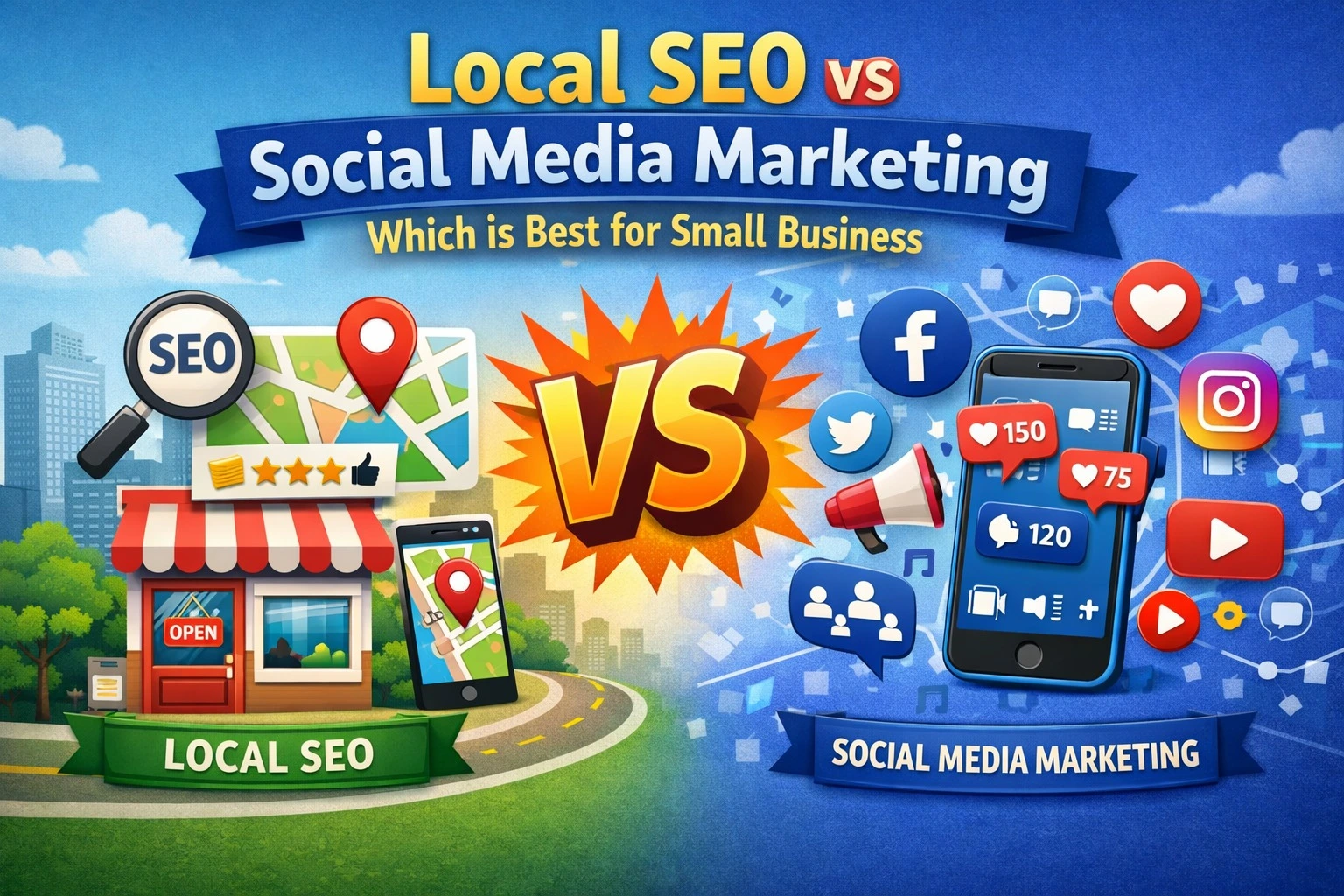
Small businesses in 2026 operate under increasing pressure to justify every marketing expense. Budgets are limited, competition is higher, and owners are expected to generate consistent leads without relying on trial-and-error strategies. In this environment, deciding where to invest in Local SEO or Social Media Marketing has become a critical business decision.
Both channels offer visibility and growth opportunities, but they deliver results in fundamentally different ways. Local SEO focuses on capturing customers with immediate purchase intent, while Social Media Marketing emphasizes brand presence and audience engagement. Choosing the wrong priority often leads to wasted spend, inconsistent enquiries, and unclear return on investment. This guide provides a practical comparison of Local SEO and Social Media Marketing as they perform in 2026. It evaluates costs, lead quality, and long-term value, helping small businesses make informed investment decisions based on measurable outcomes rather than assumptions.
Understanding Local SEO
Local SEO focuses on helping your business appear when customers search for nearby services. These searches often include phrases like “near me,” “in Delhi,” or “best service provider.” Local SEO primarily revolves around:
Google Business Profile optimization
This ensures your business appears prominently in Google Maps and local search results. Optimizing business details, categories, images, services, and regular updates improves visibility and increases calls, directions, and website visits from nearby customers.
Local keywords
Local keywords target searches that include a specific city, area, or “near me” intent. Using these terms helps your business rank when potential customers actively search for services in your location, leading to higher-quality traffic.
Reviews and ratings
Customer reviews directly influence local rankings and buying decisions. Consistent positive reviews build trust, improve click-through rates, and signal credibility to both users and search engines.
Location-based landing pages
These pages focus on individual service areas or cities. They help businesses rank for multiple locations, provide relevant information to local visitors, and increase conversion rates by matching search intent more precisely.
Why Local SEO is powerful now
Local SEO is powerful now because search behavior in 2026 is driven by immediate intent and location-based decisions. Investing in Local SEO Services in India helps businesses improve Google Maps visibility, attract high-intent local customers, generate more enquiries, and build a strong long-term online presence.When users search for services, Google increasingly prioritizes results that can solve the problem quickly and nearby. Features such as map packs, AI-generated local summaries, voice search, and “near me” queries push locally optimized businesses to the top, even above large national brands. This shift allows small businesses to compete on relevance rather than budget.
At the same time, consumer trust has become more selective. Users rely heavily on business profiles, reviews, photos, and accurate location data before making contact. A well-optimized local presence signals credibility and reduces hesitation at the decision stage. Unlike paid ads or social media campaigns that stop delivering once spending ends, Local SEO builds long-term visibility. Once a business earns strong local rankings, it continues to generate consistent enquiries, calls, and visits with lower ongoing costs, making it one of the most reliable and cost-efficient marketing channels for small businesses today.
Understanding Social Media Marketing
Social Media Marketing focuses on visibility, engagement, and brand awareness across platforms like Instagram, Facebook, LinkedIn, and YouTube Shorts.Businesses use social media to:
Build brand recall
Social media helps businesses stay visible in front of their target audience over time. Regular exposure through posts, stories, and videos ensures that when customers are ready to buy, the brand feels familiar and trustworthy.
Engage with audiences
Platforms enable two-way communication through comments, messages, and interactions. This engagement builds relationships, answers questions quickly, and strengthens customer confidence in the brand.
Promote offers
Businesses use social media to highlight discounts, launches, and time-sensitive promotions. This allows brands to reach existing followers and new audiences with targeted messaging.
Run paid ads
Paid social ads expand reach beyond organic followers. Businesses can target users based on location, interests, and behavior, making ads useful for awareness campaigns and retargeting potential customers.
Why social media still matters
Social media still matters because it plays a critical role in brand perception and trust-building, even when it is not the primary source of direct leads. In 2026, customers rarely make decisions after seeing a business only once. They research, compare, and validate before taking action—and social media profiles often serve as that validation layer. An active, professional presence reassures potential customers that the business is legitimate, responsive, and relevant.
Social platforms also influence buying decisions indirectly. While users may discover a service through Google search, they often visit social profiles to evaluate credibility, recent activity, customer interactions, and overall brand tone. Social media further supports remarketing, allowing businesses to stay visible to users who have already shown interest but are not ready to convert immediately. When combined with Local SEO, social media strengthens recall, improves conversion confidence, and supports long-term customer relationships, making it a valuable supporting channel in a balanced marketing strategy.
Local SEO vs Social Media Marketing
| Factor | Local SEO | Social Media Marketing |
| Primary goal | Lead generation | Brand awareness & engagement |
| Cost over time | Lower (long-term) | Higher (ongoing ads & content) |
| Speed of results | Slow initially, stable later | Fast but short-lived |
| Lead intent | High | Medium to low |
| Long-term ROI | Very high | Moderate |
| Dependency | Google algorithm | Platform algorithms & trends |
Real Case Study: Local Service Business in Delhi NCR
A home renovation company in Delhi NCR invested in digital marketing for 12 months. The goal was to generate consistent leads without increasing ad spend every month.
Strategy Used
First 6 months: Focus on Local SEO
In the first six months, the focus on Local SEO involved building a strong and sustainable foundation for organic visibility. The business started by fully optimizing its Google Business Profile, ensuring accurate business information, service categories, location details, images, and regular updates. This helped the brand appear more frequently in local map results and relevant search queries.
At the same time, the website was optimized with location-specific keywords aligned to actual search intent. Dedicated landing pages were created for core services and target areas, allowing the business to rank for multiple local searches. Efforts were also made to improve on-page SEO, internal linking, and mobile usability, which are critical ranking factors for local searches in 2026.
Last 6 months: Added social media ads
In the last six months, the business added social media advertising to support and amplify the organic visibility built through Local SEO. Instead of starting from zero, ads were targeted toward users who had already interacted with the website, Google Business Profile, or previous content. This remarketing-focused approach reduced wasted spend and improved ad efficiency.
Social media ads were used to promote specific services, seasonal offers, and trust-building content such as client testimonials and completed project visuals. Platform targeting was refined by location, interests, and behavior to stay aligned with the local audience. Rather than relying on social media for primary lead generation, ads reinforced brand recall and encouraged repeat exposure, helping undecided users convert. As a result, social media ads complemented Local SEO efforts by increasing conversion confidence and supporting steady lead growth without significantly increasing overall marketing costs.
Results
| Metric | Before SEO | After 12 Months |
| Monthly website visits | 300 | 2,400 |
| Google Business Profile calls | 15/month | 120/month |
| Cost per lead | ₹1,200 | ₹280 |
| Social media leads | 0 | 20–30/month |
Key takeaway
Local SEO delivered 70% of total leads with lower cost. Social media helped with visibility and retargeting but did not outperform Local SEO in direct conversions.
Where Local SEO Wins Clearly
Customers search with buying intent
Local SEO captures users who are actively looking for a product or service in their area. These users often have a strong intent to purchase, book, or contact, which makes leads generated through Local SEO highly valuable and more likely to convert.
You serve a specific city or region
Local SEO is most effective for businesses targeting a defined geographic area. Optimizing for local searches ensures that your business appears prominently when nearby customers search for services you offer, giving you a competitive advantage over non-local or national competitors.
You want predictable, long-term leads
Once properly optimized, Local SEO generates a steady stream of organic traffic and enquiries without the need for continuous spending. This makes lead flow more predictable and reduces reliance on paid campaigns for consistent results.
You rely on phone calls, visits, or enquiries
Local SEO directly supports conversion channels like calls, store visits, or service bookings. Optimized business listings, local landing pages, and reviews guide potential customers to take immediate action, resulting in measurable and high-quality leads.
Where Social Media Marketing Makes Sense
You sell visual or lifestyle-driven products
Social media thrives on visually engaging content. Products like fashion, home décor, food, or fitness services perform best because photos, videos, and reels can capture attention quickly and create desire. Visual storytelling helps customers connect with the brand emotionally, which can influence purchase decisions.
You launch new offers frequently
If your business regularly introduces promotions, discounts, or seasonal products, social media allows immediate and widespread visibility. Ads and posts can highlight time-sensitive offers, helping generate quick engagement and prompt action from your audience.
You want brand recall among younger audiences
Younger consumers Gen Z and Millennials spend significant time on social platforms. Social media is ideal for building familiarity and keeping your brand top-of-mind with these demographics, ensuring they think of your business when making purchasing decisions.
You already have basic Local SEO in place
Social media works most effectively as a complementary channel. When Local SEO establishes organic visibility and credibility, social media can amplify awareness, support retargeting, and reinforce trust. Without a strong local presence, social media alone may generate engagement but fewer high-intent leads.
Final Verdict: Where Should Small Businesses Invest?
In 2026, Local SEO continues to deliver superior return on investment (ROI) for small businesses because it directly targets users with immediate buying intent. When potential customers search for services or products in a specific area, Local SEO ensures your business appears in search results and map listings, making it far more likely that these users will contact you, visit your store, or make a purchase. Unlike social media campaigns, which often generate engagement metrics like likes, shares, or comments, Local SEO focuses on conversions that matter, turning searches into tangible leads and revenue.
Local SEO also provides long-term stability. Once a business earns strong local rankings through optimized business profiles, location-specific landing pages, and positive reviews, these rankings continue to generate enquiries consistently with minimal ongoing costs. Social media, on the other hand, relies heavily on constant content creation and paid promotion. Organic reach is limited, and trends change rapidly, meaning the moment posting or ad spend stops, visibility and engagement drop. For small businesses looking to establish a strong, lasting local presence, working with experienced partners like Pointer Soft Technologies can make this process more efficient. Their expertise in Local SEO ensures that business profiles, websites, and reviews are fully optimized to capture high-intent local traffic, helping companies generate quality leads while minimizing wasted marketing spend.
Frequently Asked Questions (FAQ)
Is Local SEO better than social media for small businesses?
Yes, for lead generation and local visibility, Local SEO performs better because it targets users with strong purchase intent.
How long does Local SEO take to show results?
Most businesses see measurable improvement within 3–6 months, with strong results after 6 months.
Can social media replace Local SEO?
No. Social media creates awareness, but it does not replace search intent or map-based discovery.
Should small businesses stop social media marketing?
No. They should use social media strategically, not rely on it as the primary lead source.
What is the best marketing mix for 2026?
Local SEO as the foundation, supported by social media content and selective paid ads.