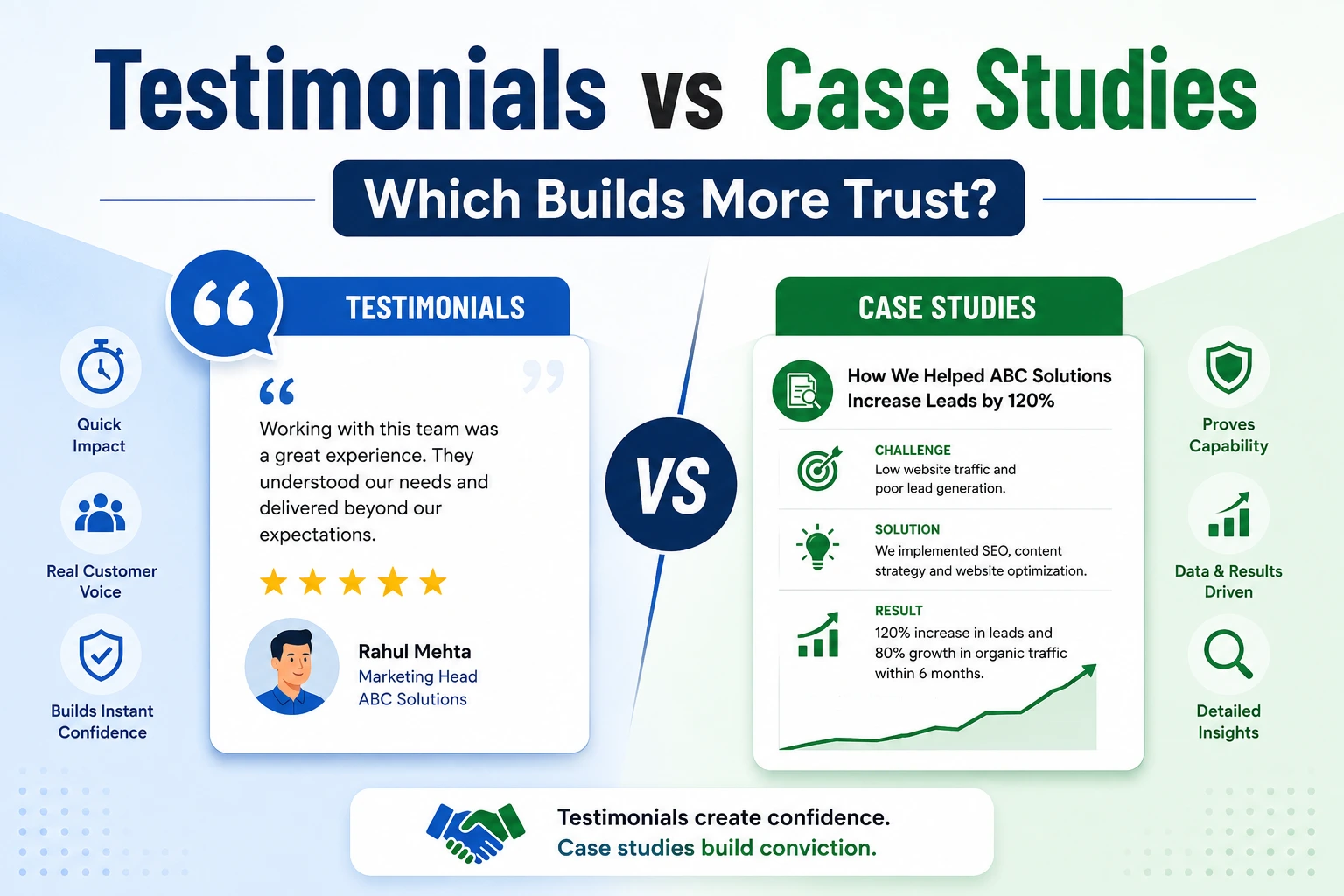
A website can have an attractive design, strong services and persuasive marketing copy, yet visitors may still hesitate to contact the business. The reason is simple: people do not automatically trust what a company says about itself. They want to know whether other customers had a positive experience and whether the business can actually deliver what it promises. This is where testimonials and case studies become important. Both provide social proof and trust signal, but they work differently. Testimonials offer quick reassurance, while case studies provide a deeper look at how a business solves real customer problems. Understanding the difference can help you decide which one deserves more space on your website.
What Is a Testimonial?
A testimonial is a customer’s statement about their experience with a company, product or service. It usually focuses on satisfaction, service quality, communication, results or the overall customer experience.
For example, a customer might say that a website development company understood their requirements, communicated clearly and delivered the project as expected. Visitors can understand the message quickly without reading a long customer story.
Testimonials work particularly well on homepages, service pages and landing pages because they provide quick social proof without interrupting the visitor’s browsing experience.
What Is a Case Study?
A case study provides a detailed account of a customer’s problem and explains how a business addressed it. Instead of presenting only an opinion, it shows the journey from the original challenge to the solution and eventual outcome.
A good case study usually discusses the customer’s situation, the problem they wanted to solve, the strategy used, the work completed and the outcome. Depending on the business, it may also include screenshots, project details, timelines, measurable improvements or customer feedback.
This makes case studies particularly useful for services where customers need more information before making a decision.
Testimonials vs Case Studies: Key Differences
Testimonials and case studies both support credibility, but they serve different purposes. A testimonial focuses mainly on what the customer thinks about the experience, while a case study focuses on what the business did and what happened afterward.
| Factor | Testimonials | Case Studies |
| Length | Short to medium | Detailed |
| Main purpose | Quick social proof | Detailed proof of capability |
| Customer focus | Experience and satisfaction | Problem, solution and outcome |
| Reading time | Low | Higher |
| Best placement | Homepage and service pages | Dedicated case study pages |
| Best for | Quick trust building | High-consideration decisions |
| Detail level | Usually limited | Usually extensive |
| Content effort | Easier to collect | Requires more preparation |
Therefore, neither option is universally better. The right choice depends on the customer’s stage in the buying journey.
When Should You Use Testimonials?
Testimonials work best when visitors need a quick reason to trust your business. Someone visiting your homepage may not want to read a detailed project story. They may simply want confirmation that other customers have had a good experience.
For example, a visitor searching for a website designing company may look at your portfolio, services and customer feedback before deciding whether to contact you. A relevant testimonial near the service information can reduce hesitation.
Testimonials also work well for local businesses because customers often want to know whether other people in their market have trusted the company. A genuine customer statement can make a business appear more approachable and credible.
When Should You Use Case Studies?
Case studies become more valuable when the customer needs detailed evidence before making a decision. This commonly happens with expensive, complicated or customised services.
For example, someone looking for SEO services may want to understand more than whether previous customers were satisfied. They may want to know what challenges those customers faced, what strategy the agency used and what kind of progress the campaign produced.
A case study gives you the space to explain that journey. It can also help prospects identify similarities between their situation and a previous customer’s problem.
Customer Reviews vs Testimonials vs Case Studies
These three forms of customer proof often appear similar, but they perform different jobs.
| Factor | Customer Reviews | Testimonials | Case Studies |
| Typical length | Very short | Short to medium | Long |
| Main purpose | Reputation | Social proof | Demonstrate capability |
| Detail | Low | Medium | High |
| Source | Often public platforms | Usually selected customers | Specific customer projects |
| Best use | Local trust | Website conversion | Complex buying decisions |
| Typical content | Rating and opinion | Experience and recommendation | Problem, solution and outcome |
Reviews can establish general reputation, testimonials can strengthen confidence on your website, and case studies can demonstrate how you approach real business challenges.
What Makes a Testimonial Trustworthy?
Not every testimonial carries the same level of credibility. Generic statements such as “Excellent company” or “Great service” provide little useful information because they could describe almost any business. A stronger testimonial explains something specific about the customer’s experience. It might mention the problem they had, the service they received, the quality of communication or an improvement they noticed.
When permission is available, adding the customer’s name, designation, company name or photograph can provide additional context. Businesses should never edit customer feedback in a way that changes its original meaning. The goal should be authenticity rather than exaggerated praise.
What Makes a Case Study Trustworthy?
A case study becomes convincing when it provides enough information for the reader to understand what actually happened. Start with the customer’s situation and explain the problem clearly. Then describe the solution without turning the entire section into promotional copy. Finally, explain the outcome using verifiable information whenever possible.
Screenshots, project examples, timelines, deliverables, customer comments and measurable results can strengthen the story. If exact results cannot be publicly disclosed, do not invent percentages or revenue figures simply to make the case study look impressive. You can describe the improvement honestly without revealing confidential information.
Where Should You Place Testimonials on a Website?
The placement of a testimonial can influence how useful it becomes. Putting all customer feedback on a separate page may not be enough because many visitors will never visit that page.
Instead, place relevant testimonials close to the information they support.
A homepage can use testimonials to create an early sense of credibility. A service page can show feedback related specifically to that service. A landing page can use a short testimonial near the call to action to reduce hesitation before enquiry.
For example, a website designing company can display feedback from a business owner directly below its website design service information. The visitor can immediately connect the customer’s experience with the service being considered.
Where Should You Place Case Studies?
Case studies deserve dedicated pages because they usually contain more information. However, you should also link them from relevant service pages. If you have a website design case study, link it from your website design page. If you have an SEO project story, connect it with your SEO service page. This approach helps visitors discover supporting evidence while also creating useful internal links between related pages.
A clear “View Case Study” or “See How We Helped” link can encourage interested visitors to explore the complete project story.
Video vs Written Testimonials: Which Is Better?
Written testimonials are easy to scan and work well on almost every website. Visitors can read them quickly without interrupting their browsing experience. Video testimonials can create a stronger personal connection because visitors can see and hear the customer. Facial expressions, voice and natural communication can make the experience feel more authentic.
However, video does not automatically make a testimonial better. A genuine, specific written testimonial can be more useful than a vague video. Choose the format based on your audience, website design and the quality of customer feedback you can obtain.
Generic vs Specific Testimonials
Specific testimonials usually provide more value than generic praise.
Consider the difference.
Generic:
“Excellent service. Highly recommended.”
Specific:
“The team understood our website requirements, explained the process clearly and delivered a mobile-friendly website that was easier for our customers to navigate.”
The second example gives the reader context. It explains what the customer needed and what they appreciated.
When requesting testimonials, ask customers about their original problem, their experience during the project and what they liked about the final outcome. These questions can produce much more useful responses.
How to Collect Better Testimonials
Instead of asking customers to simply “write a review,” ask specific questions. You can ask what problem they wanted to solve, why they selected your company, what they liked about the process and whether anything improved after the service. This approach makes it easier for customers to remember specific details.
You should also request permission before publishing their name, photograph, company details or project information. If a customer wants certain information kept private, respect that preference. Authentic feedback builds more trust than heavily edited promotional statements.
Do Testimonials and Case Studies Work Better Together?
Yes. You do not need to choose one and ignore the other.
A testimonial can capture attention quickly, while a case study can answer the deeper questions that arise after the visitor becomes interested.
Think of the journey this way:
Testimonial → Initial Trust → Interest → Case Study → Detailed Evaluation → Enquiry
For example, a visitor may first notice a customer’s short testimonial on a service page. If they want more evidence, they can follow a case study link and learn how the company handled a similar project. This creates a natural trust-building process without forcing every visitor to read lengthy content.
Final Verdict: Testimonials vs Case Studies
So, which builds more trust?
Testimonials are better for quick credibility. Case studies are better for detailed proof.
Testimonials help visitors see that real customers have trusted your business. Case studies help them understand how your business approaches problems and delivers solutions.
The strongest websites use both strategically. Add authentic testimonials to important conversion pages and create detailed case studies for projects that demonstrate your expertise. Support them with reviews, portfolio examples and other genuine trust signals.
Most importantly, avoid exaggeration. Trust grows when customers can see real experiences, specific details and honest evidence, not when a website simply makes bigger claims.
FAQs
1. Are testimonials better than case studies?
Neither is universally better. Testimonials provide quick social proof, while case studies provide detailed evidence. Businesses can benefit from using both.
2. What is the difference between a testimonial and a case study?
A testimonial usually shares a customer’s opinion or experience in a short format. A case study explains a customer’s problem, the solution provided and the resulting outcome in greater detail.
3. Should testimonials be placed on the homepage?
Yes. Testimonials can work well on the homepage because they provide quick credibility to first-time visitors. You can also place relevant feedback on individual service and landing pages.
4. How long should a case study be?
There is no fixed length. A case study should contain enough information to explain the problem, solution and outcome without adding unnecessary details. For most business websites, clarity matters more than word count.
5. Are video testimonials more trustworthy?
Video can create a stronger personal connection, but authenticity matters more than format. A specific written testimonial can be more convincing than a vague video testimonial.
6. Should businesses use customer reviews and testimonials together?
Yes. Reviews can demonstrate general reputation, while testimonials can provide more relevant customer experiences on your website. Using both can create stronger social proof.
7. What makes a testimonial credible?
Specific details, authentic customer language and identifiable information such as a name, designation or company name can make a testimonial more credible when the customer has given permission to publish them.
8. Do case studies help generate leads?
Case studies can support lead generation by showing prospects how a business handled real problems. They become especially useful when customers need substantial evidence before purchasing a complex or high-value service.