Search is moving beyond traditional blue links. People now ask AI-powered search experiences for recommendations, comparisons, explanations and business information. Google has expanded generative experiences such as AI Overviews and AI Mode, while platforms such as ChatGPT and Perplexity also provide answers by combining information from multiple sources.
This shift has introduced a new digital marketing concept: Generative Engine Optimization (GEO).
GEO focuses on improving the chances that AI-powered search systems can discover, understand, trust and potentially cite or mention your business and its content. However, GEO is not a replacement for SEO. Google’s current guidance explicitly says that SEO best practices remain relevant for generative AI search because these experiences rely on Google’s existing ranking and quality systems.
What Is Generative Engine Optimization (GEO)?
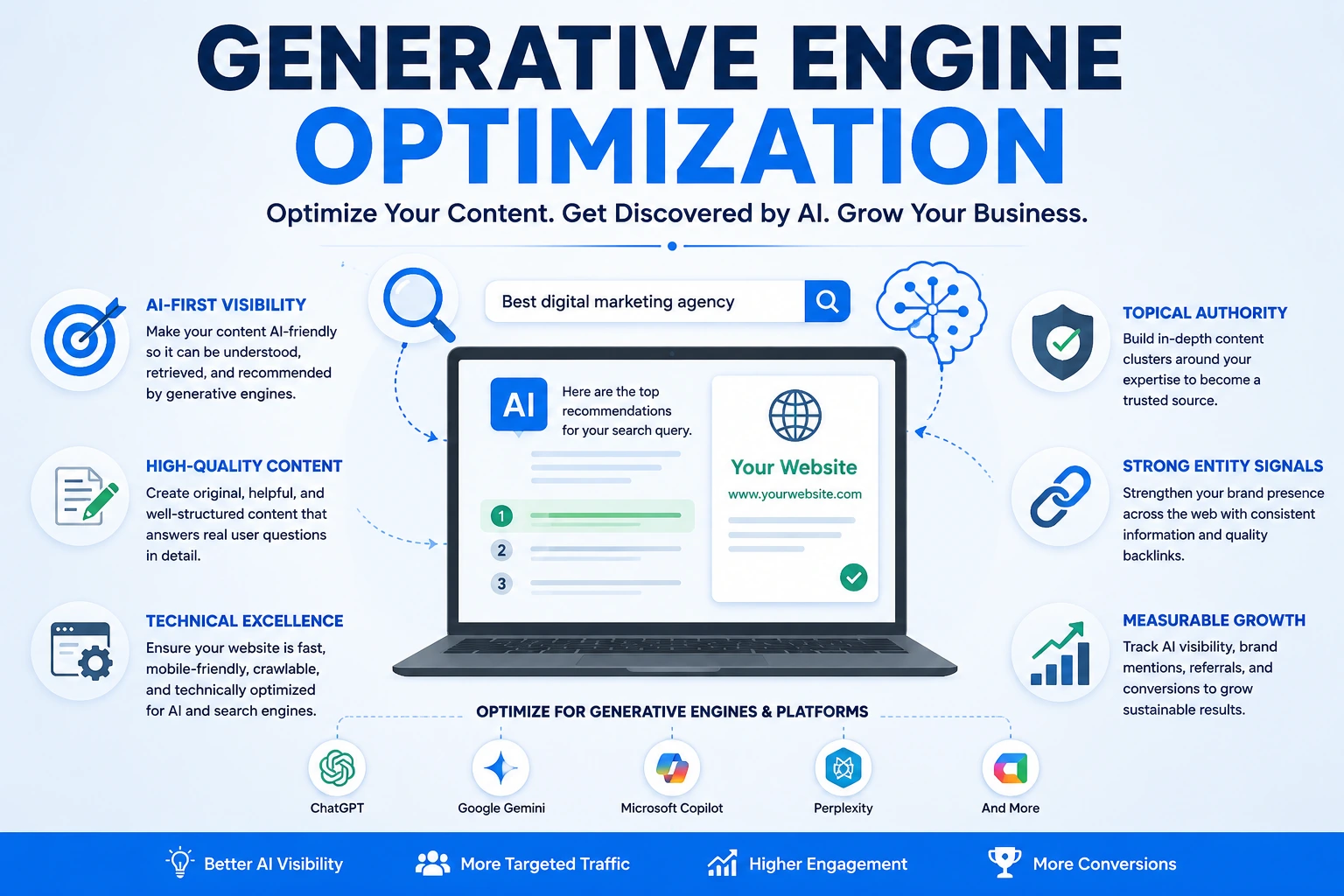
Generative Engine Optimization (GEO) is the practice of optimizing a website and its content for visibility in AI-generated search responses.
Traditional search generally presents a list of webpages ranked for a query. Generative search can instead retrieve information from several sources and produce a synthesized response.
For example, a user might search:
“What is the best website design company for a small business in India?”
Instead of simply displaying websites, an AI-powered search experience may provide a summarized answer and cite several sources.
GEO aims to make your website a clear, useful and trustworthy source of information that these systems can understand and potentially use.
Research on GEO shows that generative search can behave differently from traditional search, including differences in which sources it selects and how it presents information.
Why Does GEO Matter for Businesses in 2026?
The way people search is becoming more conversational.
Instead of searching:
“SEO company Noida”
a user might ask:
“Which SEO companies in Noida can help a small business generate local leads?”
The second query contains more context and requires the search system to understand the user’s needs.
This creates a new opportunity for businesses. A company that publishes detailed, trustworthy and useful information can potentially become part of AI-generated answers.
Google’s current guidance also encourages website owners to focus on unique, valuable, non-commodity content rather than chasing supposed AI-search tricks.
Traditional SEO vs GEO
SEO and GEO overlap heavily, but their visibility goals differ.
| Factor | Traditional SEO | GEO |
| Main goal | Improve visibility in search results | Improve visibility in AI-generated responses |
| Search format | Ranked webpages | Synthesized answers |
| Primary focus | Rankings and organic traffic | Mentions, citations and AI visibility |
| Keyword strategy | Keywords and search intent | Topics, entities, questions and context |
| Content | Helpful, relevant content | Helpful, clear and extractable information |
| Authority | Links, content, reputation and other signals | Authority, relevance, trusted sources and evidence |
| User queries | Often keyword-based | Frequently conversational and detailed |
| Measurement | Rankings, impressions, clicks | AI mentions, citations, referrals and conversions |
| Technical SEO | Essential | Still essential |
| Structured data | Useful where appropriate | Useful for helping systems understand content |
| Long-term approach | Build organic authority | Build authority across search and AI experiences |
The important takeaway is simple: GEO should complement SEO rather than replace it.
How Does GEO Work?
AI-powered search systems can retrieve information from websites and use that information to formulate answers. Google’s documentation describes its generative search experiences as using information from the Search index and techniques such as retrieval and query fan-out to find relevant information.
Your website therefore needs to make its information easy to discover and understand.
A strong GEO strategy focuses on several areas.
1. Create Original and Helpful Content
Generic content provides little differentiation.
Instead of publishing another basic article about SEO, create content based on genuine expertise, experience, research and customer questions.
For example:
Weak topic:
“Benefits of SEO”
Stronger topic:
“How Local SEO Helps Small Businesses Generate Qualified Leads in India”
The second topic provides a specific problem, audience and outcome.
Google recommends creating unique, useful content that provides value beyond commonly available information.
2. Answer Specific Questions
AI search users often ask complete questions.
Build content around questions such as:
- What is GEO?
- How does GEO differ from SEO?
- How can businesses appear in AI search?
- How does AI search select sources?
- How can local businesses improve AI visibility?
- Does traditional SEO still matter for AI search?
Give a direct answer first and then provide supporting details.
This structure makes your content easier for users to scan and easier for systems to interpret.
3. Build Strong Topical Authority
One page cannot establish complete expertise around a subject.
Suppose you offer digital marketing services. You could create supporting content around:
Digital Marketing → SEO → Local SEO → Google Ads → Social Media → Content Marketing → AI Search → GEO
Connect these related pages through relevant internal links.
This creates a clear topical structure and helps search engines understand the relationship between your pages.
4. Strengthen Your Brand Entity
AI systems need reliable information about your business.
Make your company information consistent across your:
- Website
- About page
- Contact page
- Business Profile
- LinkedIn profile
- Industry directories
- Reputable third-party websites
- Social profiles
Clearly explain who you are, what you offer, where you operate and which industries you serve.
For local businesses, maintain consistent business details across important platforms.
5. Include Evidence and First-Hand Information
AI systems need useful information to formulate reliable answers.
Add original material such as:
- Case studies
- Research
- Statistics
- Original examples
- Expert opinions
- Project experience
- Comparisons
- Step-by-step processes
A page that simply repeats information found on hundreds of websites gives users little reason to trust it.
Recent GEO research also indicates that pages with strong structure and extractable evidence can have greater influence within generated answers, although GEO remains an evolving field and no universal ranking formula exists.
6. Improve Your Technical SEO
GEO does not eliminate technical SEO.
Your website still needs:
- Crawlable pages
- Correct canonical tags
- XML sitemap
- Proper internal linking
- Mobile-friendly design
- HTTPS
- Fast and stable pages
- Correct status codes
- Appropriate structured data
- Indexable important content
Google specifically states that its generative AI search experiences build on core Search systems, making strong SEO fundamentals important.
7. Optimize for Multiple Search Intentions
A single keyword can represent different user needs.
For example:
“Website design company”
could indicate:
- Someone researching website design
- Someone comparing companies
- Someone looking for pricing
- Someone ready to hire a developer
Create content that addresses these different stages.
A strong website should therefore contain:
Informational content + commercial service pages + comparison content + pricing information + FAQs + case studies.
This gives AI systems more useful context about your business.
Does GEO Mean Keyword Stuffing?
No. Adding the phrase “GEO” repeatedly throughout a page will not automatically make it visible in AI search. The same applies to excessive headings, unnatural keyword repetition or artificially generated mentions.
Google’s current guidance specifically warns against chasing unsupported AEO/GEO tricks and emphasizes established SEO practices, useful content and real value. The better approach is:
Topic relevance + original information + expertise + clear structure + technical accessibility + genuine authority.
How Can You Measure GEO Performance?
Traditional SEO metrics remain important, but businesses should also monitor AI visibility.
Track:
- Brand mentions in AI responses
- Citations to your website
- Referral traffic from AI platforms
- Branded searches
- Leads generated from AI-related traffic
- Conversions
- Visibility for important conversational queries
Don’t judge GEO success only by the number of times an AI system mentions your company. Qualified traffic and conversions matter more than vanity metrics.
Common GEO Mistakes Businesses Should Avoid
Creating hundreds of low-value AI-generated pages
Using AI to accelerate content production does not automatically create useful content. Businesses should add original value, expertise and factual accuracy.
Ignoring traditional SEO
GEO does not replace technical SEO, keyword research, internal linking or quality content.
Chasing artificial mentions
Trying to create fake brand mentions or manipulate AI systems can create low-quality signals instead of genuine authority.
Writing only for machines
Your primary audience remains the user. Clear, useful content benefits both people and search systems.
Expecting guaranteed AI citations
No legitimate GEO strategy can guarantee that ChatGPT, Gemini, Google AI Mode or another system will mention your company for a particular query.
Frequently Asked Questions About GEO
What is Generative Engine Optimization?
Generative Engine Optimization is the process of improving a website’s content, authority and structure so AI-powered search systems can better discover, understand and potentially use the information in generated responses.
Is GEO the same as SEO?
No. GEO focuses specifically on visibility in generative AI experiences, while SEO covers broader search visibility. However, they overlap significantly, and strong SEO remains an important foundation for GEO.
Does GEO replace traditional SEO?
No. Google states that its generative AI search experiences continue to rely on core Search ranking and quality systems. Businesses should therefore continue investing in strong SEO fundamentals.
How can I optimize my website for AI search?
Create original content, answer customer questions clearly, demonstrate expertise, strengthen your brand’s online presence, maintain technical SEO and provide useful evidence and first-hand information.
Does structured data help with GEO?
Structured data can help search engines understand eligible information on webpages when implemented correctly, but businesses should not treat schema markup as a guaranteed GEO ranking or citation technique.
Does GEO improve Google rankings?
GEO itself is not a guaranteed Google ranking factor. Many GEO practices overlap with good SEO, so improving content quality, relevance and technical accessibility can benefit overall search visibility.
Is GEO important for local businesses?
Yes. Local businesses can benefit from clearly communicating their services, locations, expertise, customer information and business details across their website and other trustworthy sources.
Final Thoughts
Generative Engine Optimization (GEO) is becoming an important part of the evolving search landscape in 2026. However, businesses do not need to abandon traditional SEO or chase every new AI-search tactic.
The strongest strategy combines SEO + high-quality content + topical authority + brand credibility + technical accessibility + useful information.
Google’s current guidance makes this especially clear: for its generative AI search experiences, businesses should continue focusing on the fundamentals of SEO while creating unique, helpful and non-commodity content.
For businesses, the goal should not simply be to “rank in AI.” The real goal is to become a source that search systems and customers can understand, trust and use when making decisions.