Business growth in 2026 depends heavily on how strong your online presence is. Whether you are a startup, a local service provider, or an established small business, your website plays a major role in how customers discover, trust, and engage with your brand. But many business owners struggle with one important decision: What type of website will bring the best results?
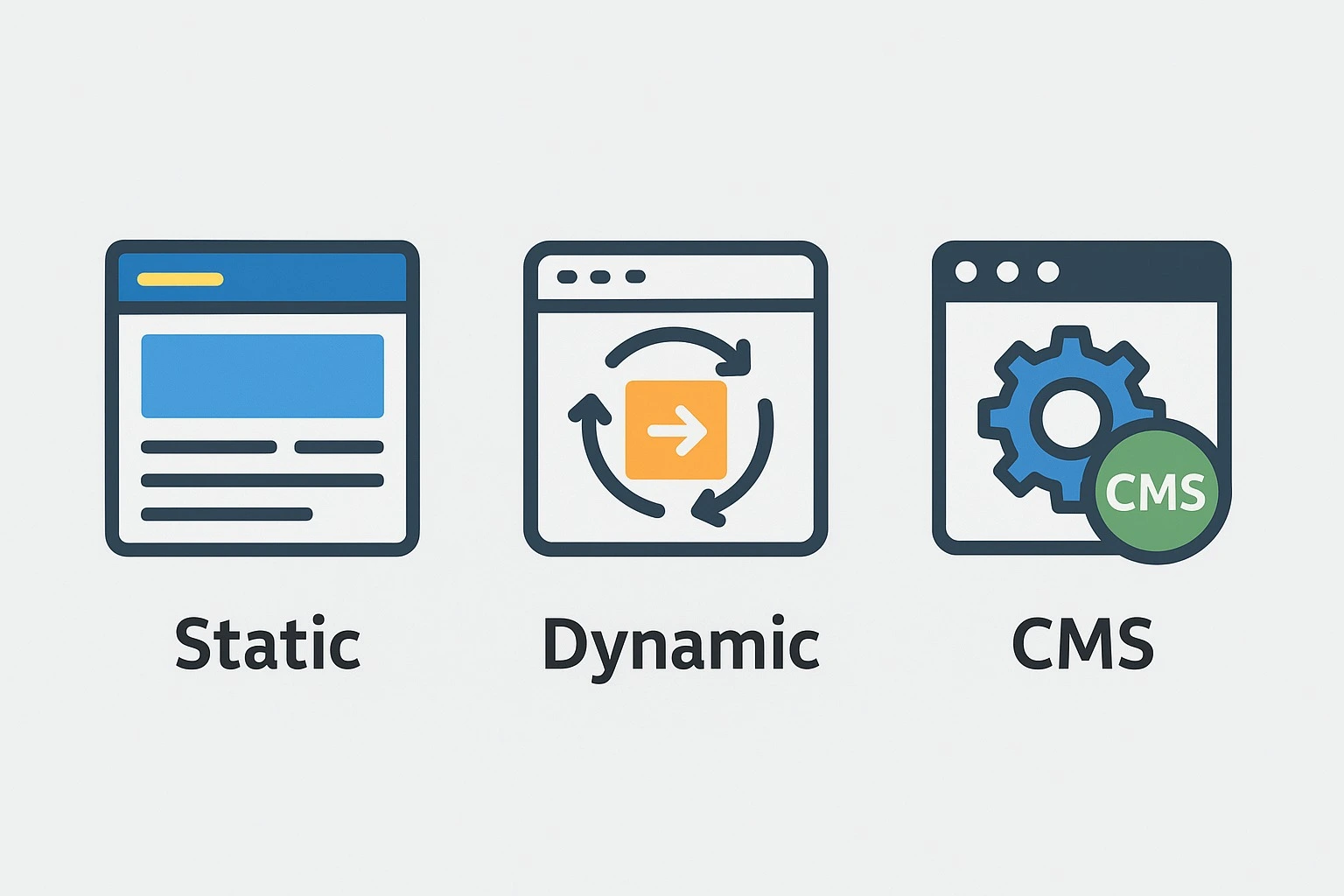
The three most common types of websites are Static, Dynamic, and CMS (Content Management System). Each offers different advantages depending on your goals, features, and budget. Understanding the differences is essential before investing in a website that supports your long-term growth.
This guide compares Static vs Dynamic vs CMS websites to help you determine which one drives more business growth in 2026.
1. Static Websites: Simple, Fast, and Cost-Effective
A static website is built using simple HTML and CSS pages. Content remains fixed unless a developer manually updates it. These websites are ideal for businesses that do not require frequent updates.
Best for:
- Small local businesses
- Doctors, clinics, salons, small agencies
- Startups with limited content
- Companies that mostly need brand information pages
Advantages:
- Lower development cost
- Fast loading speed
- Strong security
- Reliable performance with minimal maintenance
Limitations:
- Difficult to update content without technical help
- Not suitable for blogs, pricing updates, or online stores
Static websites work well for businesses that want a clean, fast, and professional online presence without ongoing updates.
2. Dynamic Websites: Smart, Flexible, and Feature-Rich
Dynamic websites are built using server-side programming languages like PHP, Python, or JavaScript. They generate pages in real time and allow frequent updates.
Best for:
- Medium to large businesses
- E-commerce stores
- Real estate, education portals, marketplace platforms
- Businesses that need user accounts, dashboards, or live data
Advantages:
- Highly interactive and scalable
- Supports automation, search features, bookings, and payments
- Perfect for SEO and content-driven growth
- Easy to add new pages and features anytime
Limitations:
- Higher development and maintenance cost
- Can be slower if not optimized properly
Dynamic websites are ideal for businesses aiming for deeper customer engagement and future scaling.
3. CMS Websites: Control Your Content Easily
A CMS (Content Management System) like WordPress, Shopify, or Wix allows business owners to manage content without coding. You can update text, images, blogs, and pages anytime.
Best for:
- Startups focusing on content marketing
- Businesses that update blogs, offers, and portfolios frequently
- Professional services, restaurants, fitness trainers, retailers
Advantages:
- Easy to manage without technical knowledge
- Thousands of design themes and plugins
- Strong SEO support
- Affordable to develop and expand
Limitations:
- Requires regular updates and security checks
- Plugin-heavy websites can slow down if not optimized
CMS websites provide full content control, which helps with branding, marketing, and SEO growth.
4. Which Website Drives the Most Business Growth in 2026?
Growth depends on your business goals rather than a single type of website being the winner. Here is a quick comparison based on purpose:
| Business Goal | Best Website Type |
|---|---|
| Simple online presence | Static Website |
| Lead generation and marketing | CMS Website |
| E-commerce and automation | Dynamic Website |
| Content publishing (blogs, news) | CMS Website |
| Real-time features (filters, accounts) | Dynamic Website |
| Low budget launch | Static Website |
| Long-term scalability | Dynamic or CMS Website |
If your business focuses on digital marketing, customer engagement, or online sales, CMS and Dynamic websites offer significantly better growth opportunities in 2026.
5. How Website Choice Affects Google Ranking and Trust
Search engines prefer websites that load fast, provide updated content, and deliver a great user experience. Static sites load quickly but lack fresh content. Dynamic and CMS websites support regular updates, which boosts SEO performance.
Also, customers trust a site that feels modern and easy to use. Features like testimonials, blogs, forms, and secure checkout increase customer confidence and lead conversions.
A website built with a growth-focused strategy will always outperform a basic presence-only website.
6. Final Thought
Choosing the right website is ultimately about choosing the right path for your business growth. Static websites offer simplicity and fast performance. Dynamic websites give you advanced features and automation. CMS websites empower you to manage content and scale your digital marketing strategy. Your business deserves a website that does more than exist. It should help you attract customers, build trust, and grow consistently in 2026 and beyond. Pointer Soft Technologies is ready to help you build it. Your digital success starts with the right platform, and the best time to begin is now.
The right choice depends on:
- Your business size and target market
- How frequently you update content
- Your long-term growth and marketing strategy
In 2026, businesses that invest in flexible and scalable websites are the ones that rank higher, convert more leads, and build stronger online authority. A modern website is not just an online presence — it is a business growth engine.
7. Frequently Asked Questions
1. Which website is best for a small business?
Small businesses benefit the most from CMS websites because they support content updates, SEO, and lead generation at an affordable cost.
2. Do static websites still work for businesses in 2026?
Yes, static websites are still effective for small businesses that only need a basic information-based site without frequent updates.
3. Which website is best for SEO?
CMS websites like WordPress are the best choice for search engine optimization due to strong content management capabilities.
4. How do I know if I need a dynamic website?
If your site requires logins, search filters, online bookings, payment integration, or real-time data, dynamic is the right choice.
5. Is it possible to upgrade from a static to a CMS or dynamic website later?
Yes, but it may require redevelopment. Choosing the right structure from the beginning saves future costs.