This is one of the most common challenges businesses face after investing in SEO, ads, and content marketing. Visitor numbers increase, impressions appear strong, and clicks continue to grow, yet enquiries, calls, and sales remain flat. This gap raises an important question. Is website traffic the real measure of success, or is website conversion what actually drives business growth?
A high traffic website may look impressive inside Google Analytics, showing rising sessions and page views. However, numbers alone do not generate revenue. A high converting website reflects its success through business outcomes such as qualified leads, customer enquiries, and sales. Understanding the difference between driving traffic and optimizing conversions fundamentally changes how businesses approach website design, user experience, and digital marketing strategy.
Understanding the Core Difference
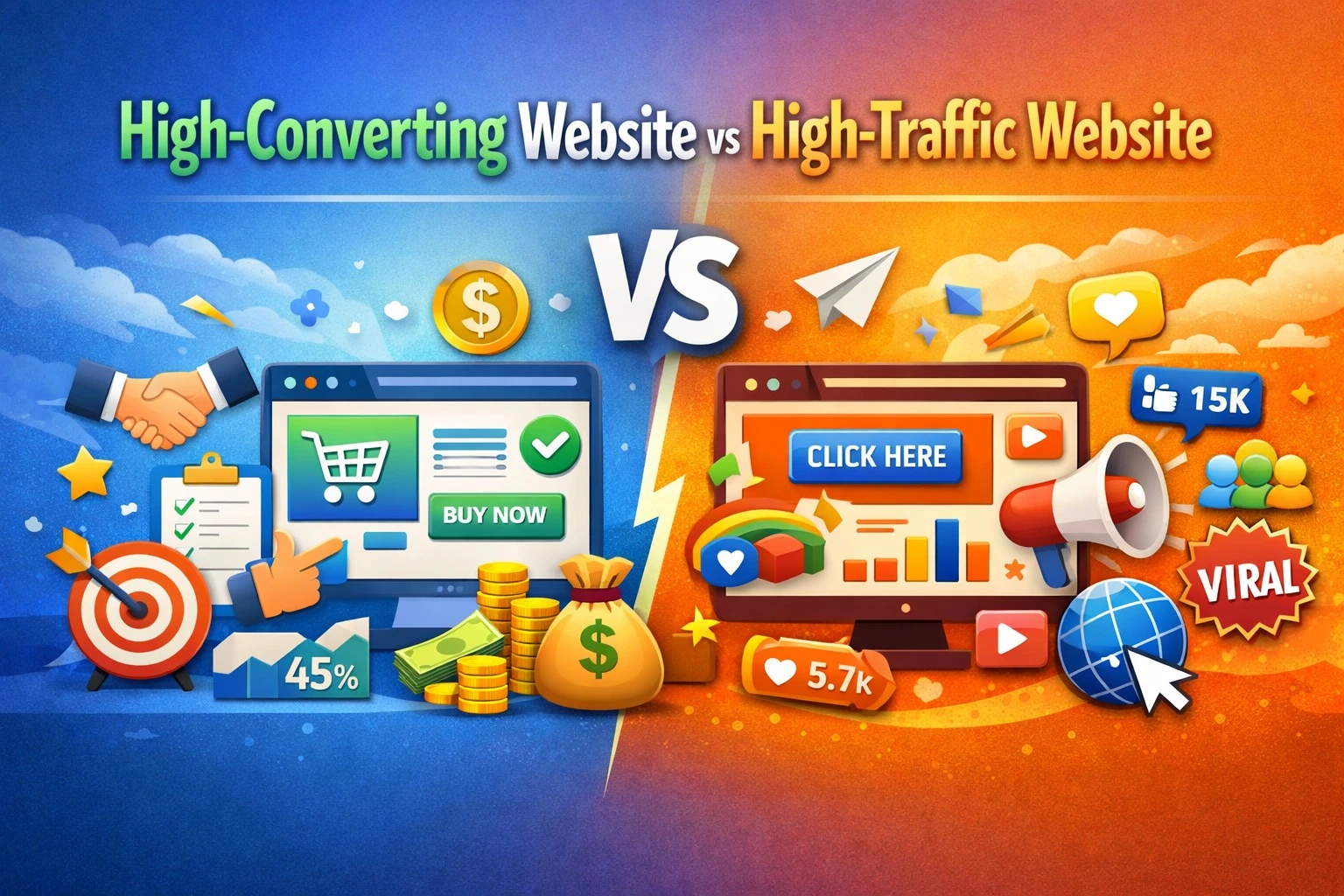
A high-traffic website is built with one primary goal in mind: getting people through the door. Its success is measured by how many visitors arrive, how often pages are viewed, and how widely the content is shared. SEO strategies target broad keywords, ad campaigns prioritize reach, and social media promotions aim to maximize clicks. While this approach increases visibility and brand awareness, it often stops there. Visitors may come in large numbers, but many leave without fully understanding the offering or taking any meaningful action. Traffic creates attention, but attention alone does not guarantee business growth.
In contrast, a high-converting website is designed with a very different mindset. Instead of focusing only on how many people visit, it focuses on what visitors do once they arrive. Every element on the site from headlines and page structure to navigation, forms, and calls to action—is intentionally crafted to guide users toward a specific outcome. This could be submitting an enquiry, making a phone call, booking a demo, or completing a purchase. The website removes friction by simplifying choices, clarifying messaging, and addressing user doubts early through trust signals such as testimonials, case highlights, and clear contact information.
High-Traffic vs High-Converting: Side-by-Side Comparison
| Aspect | High-Traffic Website | High-Converting Website |
| Primary goal | More visitors | More leads or sales |
| Main focus | SEO, ads, reach | UX, messaging, trust |
| Success metric | Sessions, pageviews | Conversion rate, enquiries |
| Business impact | Indirect | Direct and measurable |
| ROI clarity | Often unclear | Clearly trackable |
| Sustainability | Traffic drops = results drop | Performance remains stable |
Why Website Traffic Alone Does Not Generate Revenue
Many businesses assume that increasing website traffic will automatically lead to higher sales and enquiries. This belief often comes from seeing large visitor numbers in analytics tools and assuming growth is happening. In reality, traffic only represents potential interest. Revenue is created only when that interest turns into action.
Website visitors arrive with different intentions. Some are researching, some are comparing options, and others are simply browsing. If a website is not designed to guide these visitors toward a clear next step, most of them leave without engaging. Traffic without direction becomes passive data rather than business opportunity.
Another reason traffic alone fails to generate revenue is lack of clarity. Visitors decide within seconds whether a website is relevant to them. If the messaging does not clearly explain what the business offers, who it is for, and why it is different, users lose confidence and exit. High traffic only magnifies this problem by increasing the number of lost opportunities.
Trust also plays a major role. A website may receive thousands of visitors each month, but if it lacks credibility signals such as testimonials, case results, clear contact details, or professional design, visitors hesitate to enquire or purchase. People rarely make decisions without reassurance, especially in service based businesses.
Finally, traffic quality matters more than traffic volume. Attracting visitors through broad keywords or untargeted ads often brings users who were never ready to convert. Without alignment between visitor intent and the website offering, traffic numbers grow but conversions remain flat.
Revenue is generated when a website focuses on intent, clarity, trust, and ease of action. Traffic supports growth only when these elements are already in place. Businesses that understand this stop chasing visitor counts and start building websites that convert attention into measurable results.
If you want, I can next
Your Website Gets Visitors But No Leads, Here’s Why
Unclear positioning
Visitors should instantly understand what your business offers and whether it is relevant to them. When positioning is vague or filled with generic statements, users cannot quickly connect your service to their problem. This confusion leads to early exits even if the visitor arrived through targeted search or ads.
Weak first impression
The first few seconds on a website are critical. If the headline, visuals, or layout fail to communicate value immediately, visitors assume the site is not useful. A weak first impression reduces engagement regardless of how good the service may be.
Lack of trust signals
Trust is a major decision factor for online users. When a website does not show proof such as client testimonials, real results, certifications, or clear business details, visitors hesitate. Without reassurance, they are unlikely to submit a form or make contact.
Poor user experience
Complicated navigation, slow loading pages, or cluttered layouts frustrate users. Even interested visitors may leave if they struggle to find information or take action. A smooth and intuitive experience encourages users to stay and explore.
Ineffective calls to action
Visitors need clear direction. When CTAs are unclear, hidden, or use generic language, users do not feel motivated to act. Strong calls to action explain what will happen next and why the action is valuable.
Long or complicated forms
Forms that ask for unnecessary details create hesitation. Visitors prefer quick and simple interactions, especially on mobile devices. Shorter forms reduce effort and increase the likelihood of submission.
Real Case Study: Same Traffic, 3× More Leads
Business type: B2B service company
Industry: IT & web services
Location: India
The company was receiving around 30,000 monthly visitors through SEO and ads. Despite healthy traffic, they averaged only 15–18 enquiries per month.
The company was receiving around 30,000 monthly visitors through SEO and ads. Despite healthy traffic, they averaged only 15–18 enquiries per month.
What Changed
Instead of increasing traffic, they focused on conversion optimization:
- Homepage messaging was rewritten to clearly address buyer pain points
- Service pages were restructured around outcomes, not features
- Trust elements like case highlights and testimonials were added
- CTAs were simplified and made action-oriented
Result
Traffic remained nearly the same.
Enquiries increased to 55+ per month within 90 days.This case proves a critical point: conversion optimization multiplies the value of existing traffic.
Why High-Converting Websites Matter More for Businesses
They turn marketing effort into real business results
Businesses invest time and money in SEO, paid ads, and content to bring visitors to their website. A high converting website ensures that this effort results in enquiries, leads, and sales instead of just traffic numbers.
They maximize the value of every visitor
Not every business can continuously increase traffic. A high converting website focuses on extracting more value from existing visitors by guiding them toward clear actions, making growth possible without additional traffic spend.
They deliver better return on investment
When conversion rates are low, marketing budgets are wasted because visitors leave without engaging. Improving conversion performance increases the return from every marketing channel without increasing costs.
They create consistent and predictable lead flow
Traffic can fluctuate due to competition, algorithm updates, or budget changes. A high converting website reduces dependence on traffic spikes by consistently converting visitors into leads.
When Traffic Still Matters
While conversion is ultimately the most important factor for business growth, traffic still plays a critical role in a website’s success. Without visitors, there is no opportunity for conversions. The key is understanding when traffic makes a meaningful difference and how to ensure it supports business goals rather than being an isolated metric.
Traffic is essential at the top of the funnel. At this stage, potential customers are just becoming aware of your business. They may not be ready to make a purchase or submit an enquiry immediately, but exposure to your website allows them to evaluate your offerings. High quality traffic ensures that the people visiting your site are relevant, interested, and more likely to engage when guided correctly.
Another reason traffic matters is for data and insights. A website needs a sufficient volume of visitors to accurately test what works. Conversion rate optimization depends on analyzing user behavior, understanding which pages perform well, and identifying friction points. Without enough traffic, it is difficult to gather meaningful data and make informed improvements.
Traffic is also important for brand visibility and credibility. Regular visitors reinforce brand recognition, which builds trust over time. People are more likely to enquire or purchase from a brand they recognize and have seen multiple times, even if the initial visit does not convert. Repeated exposure strengthens the chance of future conversions.
Final Verdict: What Matters More?
Traffic may bring visitors, but conversion builds businesses. A high-converting website transforms attention into action and marketing spend into measurable growth.
If your website already gets visitors but struggles to generate leads, the solution isn’t more traffic, it’s better conversion strategy. Businesses that understand this shift stop chasing numbers and start building sustainable revenue. Agencies such as Pointer Soft Technologies, we help businesses design and optimize websites that not only attract visitors but also convert them into qualified leads. Our team focuses on user experience, messaging, and trust signals to ensure your website works as a true growth engine for your business.
Frequently Asked Questions
What is a high-converting website?
A high-converting website is designed to turn visitors into leads or customers by focusing on clarity, trust, user experience, and strong calls to action.
Is traffic more important than conversion?
No. Traffic creates visibility, but conversion drives revenue. A smaller audience that converts is more valuable than large, unengaged traffic.
Why does my website get traffic but no leads?
Common reasons include unclear messaging, lack of trust signals, poor UX, weak CTAs, or attracting the wrong audience.
What is a good website conversion rate?
For service-based businesses, a 2–5% conversion rate is considered healthy. High-performing websites often exceed this with optimization.
Should I improve UX or increase traffic first?
Improve UX and conversion first. Once your website converts well, increasing traffic produces far better results.
Can SEO work without conversion optimization?
SEO can drive traffic, but without conversion optimization, it rarely delivers consistent business growth.