Cart abandonment remains one of the biggest challenges for ecommerce businesses in India. Customers browse products, add items to the cart, and then leave without completing the purchase.A professionally structured ecommerce website design ensures smoother user journeys and higher conversion rates. Studies show that global cart abandonment rates often range between (60%–80%), and Indian ecommerce stores face similar trends due to pricing sensitivity, trust issues, and checkout friction.
If you run an online store, reducing cart abandonment can immediately improve revenue without increasing traffic. Let’s explore practical, proven strategies that work in the Indian ecommerce market in 2026.
Why Do Customers Abandon Carts?
Before solving the problem, you must understand the reasons behind it:
- Unexpected shipping costs
- Complicated checkout process
- Forced account creation
- Limited payment options
- Slow website speed
- Lack of trust signals
- Complicated returns policy
Indian customers compare prices quickly across platforms like Amazon India and Flipkart. If your checkout process creates even small friction, they leave instantly.
1. Simplify the Checkout Process
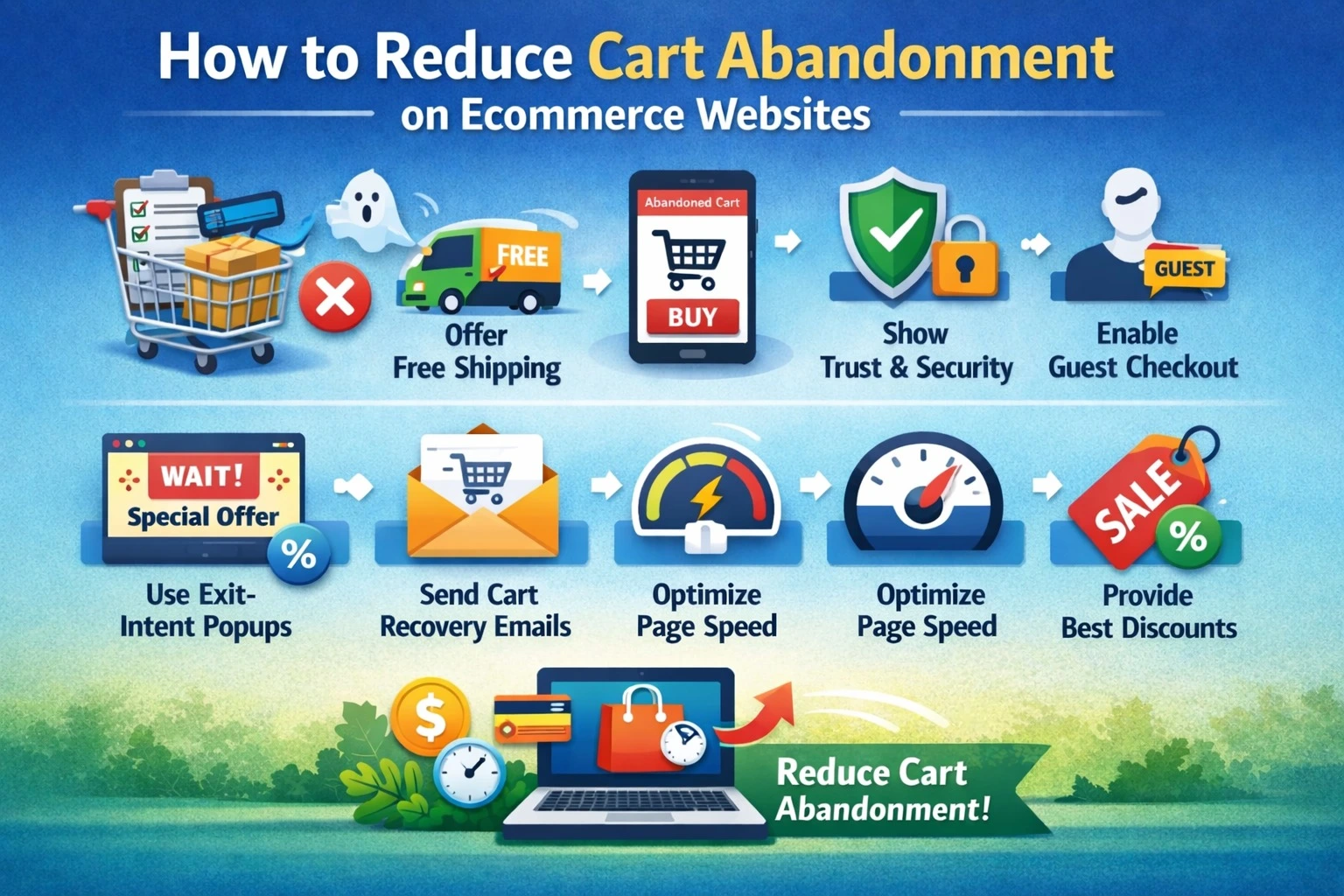
A complicated checkout process is one of the biggest reasons customers abandon their carts. When users face too many form fields, multiple pages, mandatory account creation, or confusing steps, they lose interest and leave. You should design a checkout that feels fast, simple, and friction-free. Use a one-page checkout whenever possible, remove unnecessary fields like secondary phone numbers or optional details, and allow guest checkout so customers don’t feel forced to register. Enable auto-fill for addresses using pincode lookup and clearly display order summary, shipping cost, and payment options upfront. When customers can complete their purchase in just a few clicks without confusion, they feel confident and finish the transaction. A streamlined checkout not only reduces abandonment but also increases overall conversion rates.
2. Be Transparent About Pricing
Pricing transparency plays a crucial role in reducing cart abandonment, especially in the Indian ecommerce market where customers actively compare final costs before purchasing. When users see additional charges like shipping fees, GST, handling costs, or convenience fees at the last step of checkout, they often feel misled and abandon the cart immediately. You should clearly display product price, delivery charges, taxes, and any extra fees early in the buying journey preferably on the product page or cart page itself. If possible, offer free shipping above a certain cart value and highlight it clearly to encourage higher order value.
3. Offer Multiple Payment Options
Providing multiple payment options increases trust and removes hesitation during checkout. Indian customers prefer flexibility when completing online purchases. Some users feel comfortable paying through UPI, while others prefer debit/credit cards, net banking, digital wallets, or Cash on Delivery (COD). If your website offers limited payment methods, customers may abandon their cart simply because their preferred option is unavailable. You should integrate secure and reliable payment gateways that support UPI, cards, wallets, EMI options, and COD.
4. Improve Website Speed and Mobile Optimization
Website speed and mobile performance directly influence cart completion rates. Most ecommerce traffic in India comes from smartphones, and users expect pages to load instantly. If your website takes more than a few seconds to load, freezes during checkout, or displays broken layouts on mobile screens, customers will leave without completing their purchase. You should optimize images, reduce unnecessary scripts, use fast hosting, and implement a mobile-first design approach. Ensure that buttons are easy to tap, text is readable, and forms are simple to fill on smaller screens.
5. Build Trust with Social Proof
Social proof plays a powerful role in influencing purchase decisions, especially for first-time buyers. When customers cannot physically see or touch a product, they rely on reviews, ratings, and testimonials to make informed choices. If your ecommerce website lacks visible customer feedback or credibility signals, users may hesitate and abandon their carts. You should prominently display genuine product reviews, star ratings, user-generated photos, and verified buyer testimonials on product and checkout pages. Adding trust badges, secure payment icons, return policy highlights, and clear contact information further strengthens confidence.
6. Send Automated Cart Recovery Emails & WhatsApp Reminders
Automated cart recovery messages help you bring back customers who left without completing their purchase. Many users abandon carts due to distractions, comparison shopping, or temporary hesitation not because they lost interest completely. You should set up automated email and WhatsApp reminders that trigger within 1 hour, 24 hours, and 48 hours after abandonment. The first message should act as a gentle reminder, the second can highlight product benefits or limited stock, and the third may include a small incentive like free shipping or a discount. Keep the tone helpful, not pushy, and include a direct checkout link to make the return process seamless.
7. Optimize Product Pages
Well-optimized product pages reduce doubts and increase buyer confidence, which directly lowers cart abandonment. Many customers leave because they cannot find complete information about the product, delivery timeline, return policy, or usage details. You should provide high-quality images from multiple angles, zoom functionality, clear pricing, available offers, and accurate stock status. Write detailed yet easy-to-read product descriptions that highlight benefits, specifications, and use cases. Add size guides, FAQs, shipping details, and estimated delivery dates to remove uncertainty.
8. Improve Return & Refund Policy Visibility
Clear return and refund policies reduce hesitation and increase purchase confidence. Many customers abandon their carts because they worry about receiving the wrong product, incorrect size, damaged items, or delayed refunds. If your return policy is hidden in the footer or written in complicated language, users may not feel secure enough to complete the purchase.Use simple language and highlight key points such as “7-Day Easy Returns” or “Hassle-Free Refunds.” When customers understand that they can easily return or exchange a product
9. Personalize the Shopping Experience
Personalization makes customers feel understood and valued, which increases the chances of completing a purchase. When shoppers see relevant product recommendations, recently viewed items, or tailored offers based on their browsing behavior, they engage more deeply with your website. You should use smart recommendation engines to display “You May Also Like,” “Frequently Bought Together,” or “Recommended for You” sections on product and cart pages.
10. Use Clear Call-to-Action (CTA)
A clear and compelling call-to-action guides customers toward completing their purchase without confusion. When buttons use vague words like “Submit” or “Continue,” users may hesitate because they are unsure about the next step. You should use strong, action-oriented phrases such as “Place Order Now,” “Complete Secure Payment,” or “Proceed to Checkout.” Make the CTA button visually prominent with proper contrast, adequate spacing, and mobile-friendly sizing so users can easily tap it.
Why Professional Ecommerce Design Matters
Many businesses try to fix cart abandonment with discounts. But poor design remains the core issue. A professional ecommerce website structure:
- Improves checkout flow
- Reduces friction
- Builds trust
- Enhances speed
- Supports mobile optimization
Ecommerce Development Cost in India (With Typical Figures)
When planning an ecommerce website in India in 2026, you should set realistic expectations for development costs they vary widely based on features, platform, design quality, and customization level. For a basic online store with essential elements like product catalog, cart, and payment gateway, costs typically start around ₹30,000 – ₹1,00,000. A medium-sized ecommerce site with advanced search, inventory management, and custom design usually ranges from ₹1,00,000 – ₹3,50,000. For fully customized, high-performance ecommerce solutions with complex functionality (multi-vendor, ERP integration, analytics, etc.), the cost can go above ₹5,00,000 and even reach several lakhs.
Real Case Study: Indian Fashion Ecommerce Brand
Let’s look at a real scenario from a mid-sized fashion ecommerce store based in Delhi.
Problem:
- 72% cart abandonment rate
- Slow checkout
- COD not available
- Hidden shipping costs
Actions Taken:
- Implemented one-page checkout
- Added COD option
- Displayed shipping cost on product page
- Reduced checkout load time from 6.5 seconds to 2.8 seconds
- Added trust badges and return policy visibility
Case Study Data (Before vs After Optimization)
| Metric | Before Optimization | After Optimization |
|---|---|---|
| Cart Abandonment Rate | 72% | 49% |
| Checkout Load Time | 6.5 sec | 2.8 sec |
| Conversion Rate | 1.8% | 3.6% |
| COD Usage | Not Available | 38% Orders |
| Monthly Revenue | ₹8,50,000 | ₹13,90,000 |
Result:
The brand increased revenue by nearly 63% within 4 months without increasing ad spend. This case clearly shows that proper ecommerce website optimization directly impacts revenue.
FAQs
1. What is a good cart abandonment rate in India?
An average ecommerce cart abandonment rate ranges between 60%–75%. If your rate exceeds 75%, you should optimize your checkout process immediately.
2. Does free shipping reduce cart abandonment?
Yes. Free shipping significantly increases conversions, especially for Indian customers who compare final prices across platforms.
3. How fast should an ecommerce checkout page load?
Ideally under 3 seconds. Faster load times improve trust and reduce drop-offs.
4. Is Cash on Delivery still important in India in 2026?
Yes. Many Indian customers still prefer COD, especially in Tier 2 and Tier 3 cities.
5. Can professional website design reduce cart abandonment?
Absolutely. Clean layout, mobile optimization, faster checkout, and trust signals directly impact cart completion rates.
Final Thoughts
Reducing cart abandonment requires consistent optimization, clear communication, and a seamless user experience. When you focus on speed, transparency, trust signals, mobile performance, and simplified checkout, you remove the friction that stops customers from completing their purchases. Even small improvements in checkout flow or payment flexibility can significantly increase revenue without increasing marketing spend.
If you want expert guidance in improving your store’s performance, working with an experienced ecommerce website designing company in India can make the process smoother and more strategic. Teams like Pointer Soft Technologies specialize in building conversion-focused ecommerce websites that not only look professional but also drive measurable business growth.