For businesses, a website is more than an online brochure. Its primary goal is to convert visitors into leads. One of the most direct ways to measure this is through enquiry form submissions.
Many businesses invest in digital marketing but fail to see results because their website design is not optimized to encourage submissions. The good news is that small changes in website design can dramatically increase enquiry forms completed by visitors. In this blog, we explore 8 website design features that have been proven to double enquiry form submissions for businesses.
1. Clear and Prominent Call-to-Action Buttons
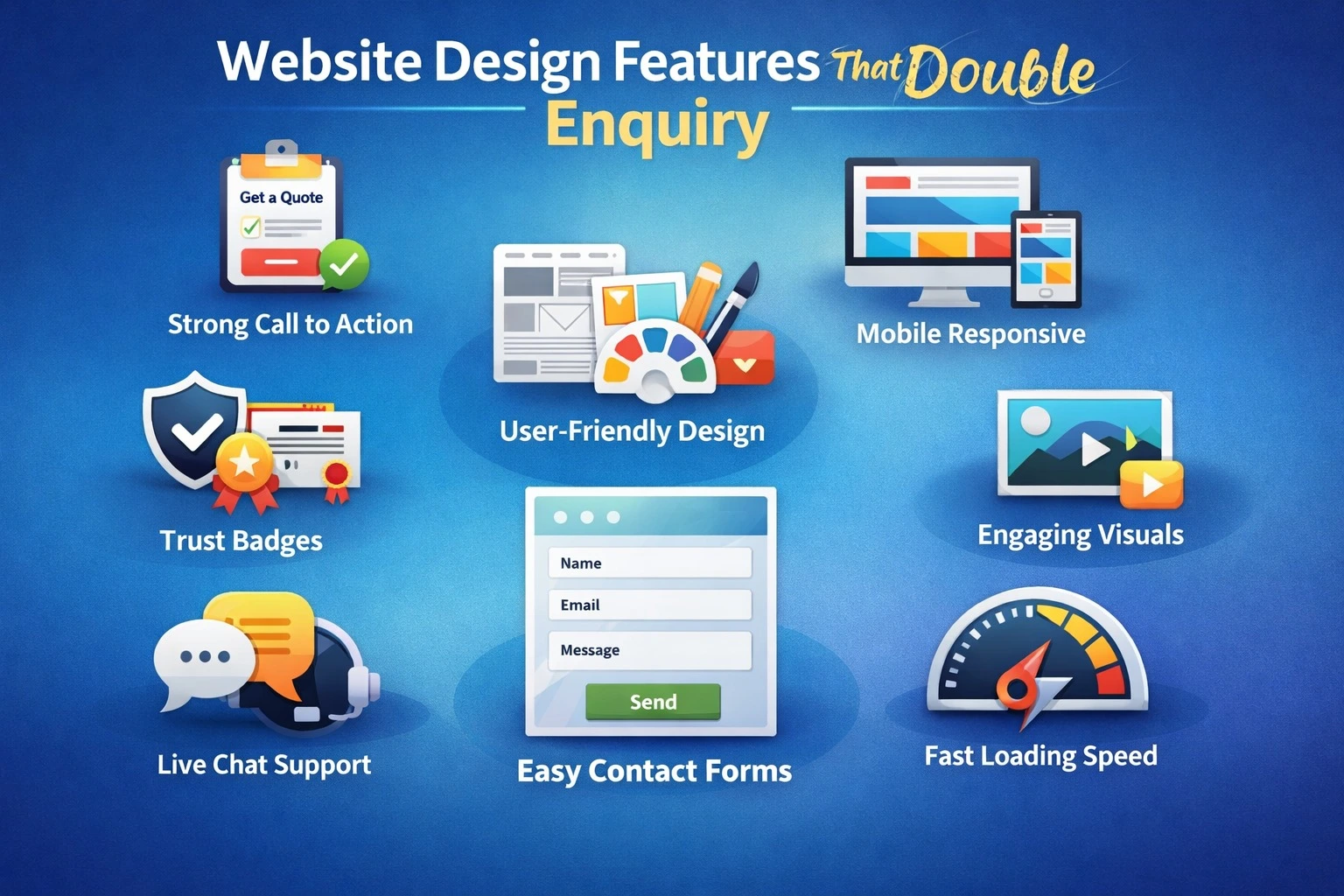
A well-designed website guides visitors toward action. Call-to-action buttons should be visible, contrasting, and concise. Visitors should immediately understand what clicking the button will do. For example, instead of generic “Submit,” use “Request Your Free Consultation” or “Get a Quote Today”. Placement matters as well. Position buttons near forms, at the end of content, and on multiple touchpoints without overwhelming the page.
2. Simplified and Short Forms
Complex forms with too many fields discourage submissions. Professional website design favors minimal forms that ask only for essential information, such as name, email, phone number, and inquiry type.
Visitors are more likely to submit a form if it takes less than a minute to complete. Progressive forms can be used for more detailed information after the initial enquiry, keeping initial barriers low.
3. Mobile-Friendly Design
Over 60% of website traffic comes from mobile devices. If forms are difficult to navigate or buttons are too small on a smartphone, visitors abandon them immediately.
A mobile-first website design ensures that forms, buttons, and pages are responsive, easy to tap, and visually clear on all screen sizes.
4. Trust Signals and Credibility Elements
Visitors hesitate to submit forms if they are unsure about the business. Adding trust signals, such as client logos, testimonials, security badges, and privacy statements, reassures users.
When visitors feel confident that their information is secure and that the business is credible, form submissions increase significantly.
5. Intuitive Layout and Visual Hierarchy
Good website design guides visitors naturally to forms. Using white space, headings, and contrasting elements, forms should stand out without disrupting the flow of content.
The placement of forms should align with the user’s reading pattern, making it easy for them to notice and complete the form as they consume information.
6. Fast Loading Speed
Slow websites frustrate visitors. Pages that take more than three seconds to load can lose over 40% of potential leads. Optimized images, clean code, and effective caching are part of professional website design that ensures fast-loading pages, keeping visitors engaged long enough to complete the form.
7. Engaging Visuals and Micro-Interactions
Visual cues such as arrows pointing to the form, animated buttons, or hover effects subtly draw attention to enquiry forms. Micro-interactions like field highlights, validation messages, and feedback on submission make the process satisfying and intuitive for users.
8. Contextual Placement of Forms
Forms work best when placed in context, after content that builds trust or explains the service. Visitors are more likely to submit a form after understanding the benefits of your service or product. Strategic placement at multiple touchpoints increases chances of conversion.
Case Study: How Website Design Doubled Form Submissions
A mid-sized IT services company struggled to generate enquiries from their website despite steady traffic. After investing in professional website design, the focus was on optimizing form placement and usability.
Key changes implemented:
- Simplified the enquiry form from 8 fields to 4
- Added client testimonials near the form
- Made call-to-action buttons prominent with clear copy
- Ensured mobile responsiveness and fast load times
- Added subtle arrows and color highlights to guide users
Results after three months:
| Metric | Before Website Design Update | After Website Design Update | Change |
| Enquiry Form Submissions | 18 per month | 42 per month | +133% |
| Bounce Rate on Form Pages | 55% | 33% | -22% |
| Mobile Form Submissions | 8 per month | 26 per month | +225% |
| Average Time on Page | 1 min 30 sec | 2 min 50 sec | +1 min 20 sec |
The improvements in website design directly impacted business outcomes, with leads more than doubling and the quality of enquiries improving.
Form Placement and Conversion Effectiveness
The placement of forms on a website directly impacts how many visitors take action. A strategically positioned form whether above the fold, at the end of engaging content, or as a sticky element makes it easier for users to convert. If forms are hidden, buried, or require too many steps, visitors are more likely to abandon the page.
| Form Placement | Conversion Rate | Notes |
|---|---|---|
| Sidebar of every page | Low | Visible but can be ignored |
| End of content page | Medium | Contextually relevant |
| Popup / Slide-in | High | Captures attention, works best with exit intent |
| Above the fold on landing page | Very High | Immediate visibility and higher engagement |
Frequently Asked Questions
Can website design really double enquiry form submissions
Yes. Optimizing form placement, length, CTA, and usability has been proven to significantly increase submissions.
Is mobile responsiveness essential for forms
Absolutely. More than half of traffic is mobile, and unresponsive forms lead to lost leads.
How long does it take to see results
Typically within 2 to 3 months after implementing professional website design improvements, measurable changes appear in enquiries.
Do I need professional developers or designers
Yes. While templates can look good, professional website design ensures usability, speed, responsiveness, and optimized layout for conversions.
Will these changes affect overall sales
Yes. Increased enquiry form submissions lead to more calls and potential customers, directly impacting sales.
Final Thoughts
Enquiry forms are often the first step in the sales funnel. Small improvements in website design can lead to significant gains in leads, calls, and revenue.
From simplified forms and clear CTAs to mobile-first design, trust signals, and visual guidance, each element works together to create a seamless experience for visitors. Businesses that invest in professional website design, such as Pointer Soft Technologies , not only enhance user experience but also maximize their website’s potential as a revenue-generating tool.
A website designed for usability and conversion is more than a digital presence. With the right expertise, it becomes a strategic business asset that drives measurable results, helping businesses attract more enquiries and convert them into loyal customers.