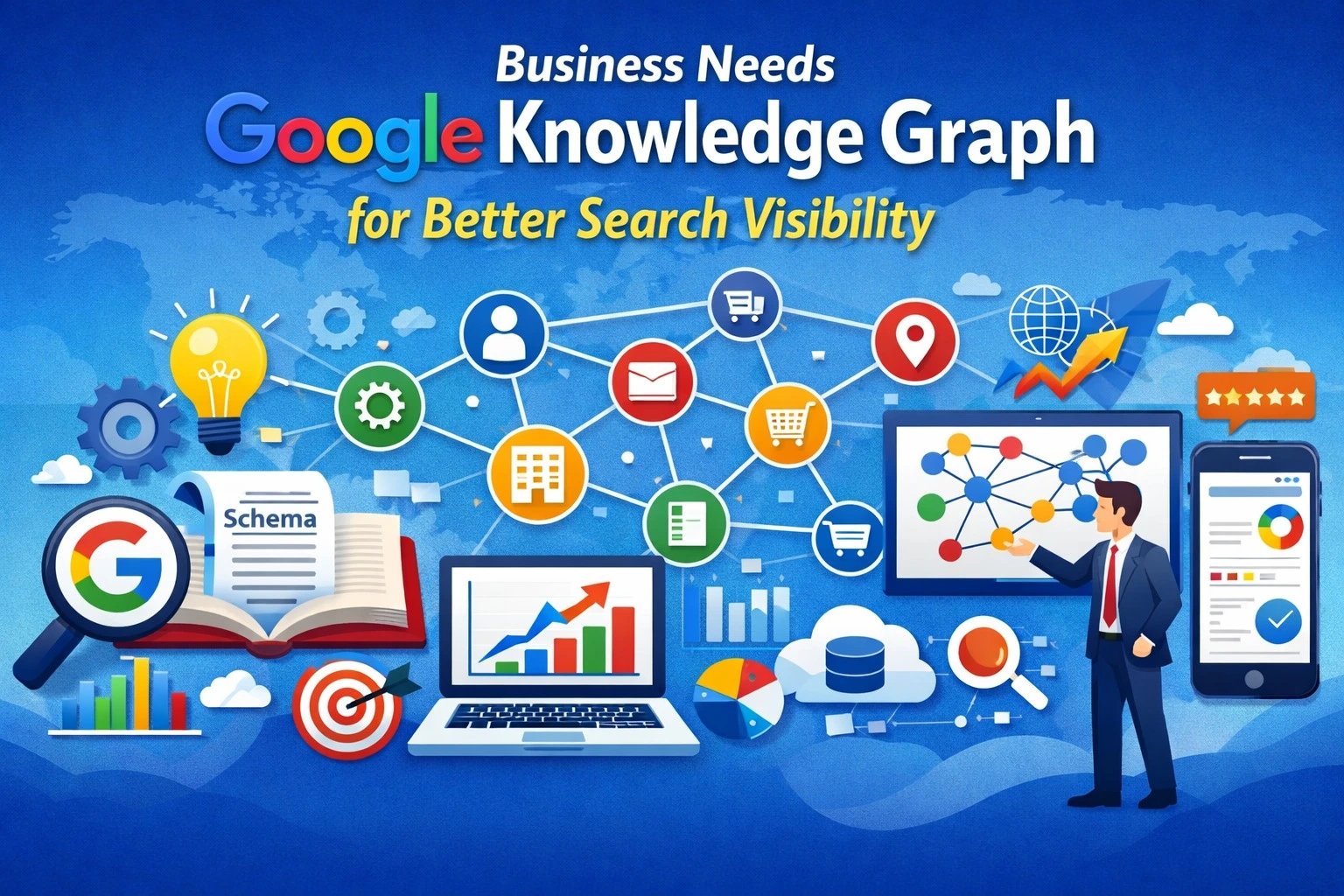
When people search for your business on Google, they don’t just look for links. They look for trust signals brand information, reviews, images, social profiles, and instant answers. This is where Google Knowledge Graph becomes a game-changer for your business visibility.
If your brand appears in Google’s Knowledge Graph, Google treats your business as a recognized entity, not just another website. That recognition directly impacts search visibility, credibility, and click-through rates. Let’s break down what Google Knowledge Graph is, why it matters, and how it can help your business attract more qualified traffic and leads.
What Is Google Knowledge Graph?
Google Knowledge Graph is Google’s intelligent system that collects, organizes, and connects information about real-world entities such as people, businesses, brands, and places. Its primary purpose is to help Google understand who or what an entity is, rather than relying only on keywords or individual web pages. Google uses Knowledge Graph to power several prominent search features, including:
- Knowledge Panels that appear on the right side of desktop search results
- Brand information boxes shown for recognized businesses
- Entity-based search results that prioritize brands over pages
- “People also search for” and related brand suggestions
Instead of displaying only a list of website links, Google presents verified and consolidated information about your business. This information may include your business name, logo, services, reviews, social media profiles, contact details, and other authoritative data gathered from trusted sources across the web.
When your business becomes part of Google’s Knowledge Graph, Google no longer sees you as just a website. It recognizes your business as a distinct, trustworthy entity. This understanding allows Google to confidently display your brand in prominent search features, improve your visibility in branded searches, and strengthen overall trust in your business.
Why Google Knowledge Graph Matters for Business Visibility
1. Google Trusts Entity-Based Businesses More
Google’s search system has evolved from ranking webpages to understanding entities. An entity is something Google can clearly define, verify, and connect to reliable sources. When your business appears in the Google Knowledge Graph, Google recognizes it as a legitimate and authoritative entity, not just another domain targeting keywords.
This trust comes from consistent signals such as structured data, brand mentions, verified profiles, reviews, and authoritative references. Once Google identifies your business as an entity, it becomes more confident in showing your brand for competitive and high-value searches. As a result, your business gains better visibility, stronger ranking stability, and increased chances of appearing in premium search features. In simple terms, Google promotes brands it understands, and Knowledge Graph is how that understanding happens.
2. You Dominate Branded Search Results
Branded searches are some of the most valuable searches because users already show intent and familiarity. When your business triggers a Knowledge Panel, Google gives your brand a dominant visual presence on the search results page.
Users Instantly See Accurate Brand Information Without Searching Further
When a Knowledge Panel appears, Google presents verified and consolidated business information directly on the search results page. Users immediately see essential details such as your business name, description, logo, services, contact information, and reviews. This removes the need for users to click multiple links or compare sources. The faster users find accurate information, the more confident they feel about your brand. This instant clarity reduces confusion and improves user experience, especially for high-intent branded searches.
Your Business Occupies Premium Screen Space
Knowledge Panels appear in a highly visible position on Google’s search results often on the right side of desktop or at the top on mobile devices. This placement gives your business prominent visual dominance on the page. By occupying premium screen space, your brand stands out visually with logos, images, and structured information. This presence increases brand recall and ensures your business attracts attention before users even scroll through traditional search listings.
Competitor Listings Get Pushed Lower on the Page
When Google displays a Knowledge Panel, it naturally pushes organic results and competitor listings further down the screen. This reduces competitor visibility and limits the chances of users clicking on alternative businesses. Even if competitors rank for similar keywords, your Knowledge Panel helps you control the narrative by keeping users focused on your brand first. This advantage becomes especially powerful in competitive industries where visibility directly impacts lead generation.
Trust Builds Before Users Even Click a Website
Knowledge Panels act as instant trust signals. When users see a verified logo, consistent business details, reviews, and social profiles, they subconsciously perceive your brand as established and reliable. This trust forms before users visit your website, increasing the likelihood that they will choose your business over others. As a result, visitors who do click through arrive with higher intent and a stronger readiness to convert.
Case Study: Service-Based Business in India
A mid-sized digital services company in India faced consistent challenges with its online visibility despite offering competitive services. The business received low branded search clicks, indicating that users were either unaware of the brand or lacked confidence in clicking its listings. Brand recognition remained weak, which allowed competitors with stronger online identities to capture attention in search results. As a result, rival companies frequently dominated branded and service-related searches, pushing this business further down the page and limiting its ability to attract high-intent traffic. These visibility issues directly impacted lead generation and slowed overall business growth.
Action Taken
To overcome visibility and brand recognition challenges, the business implemented a focused Google Knowledge Graph optimization strategy. Each action was designed to help Google clearly identify, verify, and trust the brand as a distinct entity.
Structured data (Schema Markup)
The company added structured data to its website using Organization and LocalBusiness schema. This allowed Google to clearly understand critical business details such as the company name, logo, services, contact information, and social profiles. By providing machine-readable data, the business reduced ambiguity and helped Google accurately connect the website with other brand signals across the web.
Consistent brand mentions
The business ensured that its brand name, description, and contact details appeared consistently across authoritative platforms. This consistency strengthened entity recognition and eliminated conflicting information that previously weakened trust. Repeated, accurate mentions helped Google associate the brand with its services and industry.
Google Business Profile optimization
The company fully optimized its Google Business Profile by updating service categories, business descriptions, images, and contact details. Regular posts, accurate service areas, and review management further reinforced local relevance. This optimization helped connect local signals with broader brand authority in the Knowledge Graph.
Wikipedia-style brand citations (non-promotional)
The business earned neutral, factual brand citations on high-authority sources similar in structure to Wikipedia references. These citations focused on verifiable facts rather than marketing language, which improved credibility. Google treats such references as strong trust signals, especially when they come from established and editorially controlled platforms.
Social profile alignment
All official social media profiles were aligned with consistent branding, descriptions, and links. This alignment helped Google confirm ownership and authenticity across platforms. When Google could clearly connect social profiles to the main brand entity, it strengthened overall Knowledge Graph associations.
Results After 4 Months
| Metric | Before Knowledge Graph | After Knowledge Graph |
| Branded search CTR | 1.8% | 4.9% |
| Brand name impressions | 3,200/month | 8,700/month |
| Website organic traffic | 4,500/month | 6,300/month |
| Lead enquiries | 22/month | 41/month |
| Trust signals in SERP | None | Knowledge Panel + reviews |
How Google Knowledge Graph Improves Search Visibility
Clear Brand Identity
Google connects your website, Google Business Profile, social media accounts, reviews, and brand mentions into a single, unified entity. This consistency removes confusion and helps Google clearly understand who you are and what you offer. When Google has this clarity, it confidently displays your business for relevant searches and branded queries.
Reduced Dependency on Rankings
With a Knowledge Panel, your visibility no longer depends entirely on ranking #1 organically. Even if your website appears lower in search results, your brand still gains attention through the Knowledge Panel. This ensures consistent visibility, stronger brand recall, and sustained trust regardless of keyword position.
Better Conversion Rate
Businesses with a Knowledge Panel convert faster because users feel more confident before taking action. Doubts reduce when users see verified brand details, authority increases through strong visual trust signals, and instant access to contact information makes it easier for users to reach out. This combination leads to higher-quality traffic and improved conversion rates.
How Businesses Get into Google Knowledge Graph
Creating Strong Brand Signals
Strong brand signals tell Google that your business is real, active, and trustworthy. These signals come from consistent branding, clear messaging, customer reviews, and visibility across reliable platforms. The stronger your brand presence, the easier it is for Google to recognize you as an entity.
Using Structured Data (Organization Schema)
Structured data helps Google understand your business details in a machine-readable format. By adding Organization Schema, you clearly define your brand name, logo, services, contact information, and social profiles. This reduces ambiguity and improves Google’s ability to connect your website with your Knowledge Graph entity.
Maintaining Consistent NAP (Name, Address, Phone)
Consistency in your business name, address, and phone number across all platforms builds trust. Even small variations can confuse Google and weaken entity recognition. Accurate NAP details help Google confidently associate all mentions with the same business.
Optimizing Google Business Profile
A fully optimized Google Business Profile strengthens both local and brand authority. Updated descriptions, correct categories, images, services, and regular activity help Google verify your business and improve its visibility in local and branded searches.
Getting Authoritative Mentions
Mentions from trusted, high-authority websites act as validation signals for Google. These references help confirm your brand’s legitimacy and relevance within your industry. The more credible the source, the stronger the trust signal.
Building Brand-Based Content
Brand-focused content reinforces your identity by clearly communicating who you are, what you do, and what makes you unique. This content helps Google associate your brand with specific topics, services, and expertise over time.
Long-Term, Compounding Results
Knowledge Graph optimization is not instant. However, once Google recognizes your business as a trusted entity, the benefits compound over time delivering sustained visibility, credibility, and higher-quality traffic.
Common Mistakes Businesses Make
Relying Only on Website SEO
Many businesses focus solely on keywords, backlinks, and on-page optimization, assuming this alone will deliver long-term visibility. While website SEO is important, it does not fully address how Google understands who your business is. Without entity signals such as brand mentions, structured data, and verified profiles, Google may rank your pages but still fail to recognize your brand as authoritative. This limits your ability to appear in Knowledge Panels, branded search features, and high-trust results.
Ignoring Brand Consistency
Brand consistency plays a critical role in entity recognition. When your business name, logo, description, or contact details vary across platforms, Google struggles to connect those signals into one trusted identity. Inconsistent branding weakens trust, delays Knowledge Graph inclusion, and reduces overall visibility. Consistency across websites, listings, and social platforms helps Google confidently associate all information with your business.
Incomplete Google Business Profile
An incomplete or poorly maintained Google Business Profile sends weak trust signals. Missing categories, outdated contact information, low-quality images, or inactive profiles reduce Google’s confidence in your business. Since Google Business Profile feeds directly into local and brand search results, incomplete profiles limit visibility and reduce your chances of appearing in Knowledge Panels and local search features.
No Schema Markup
Without schema markup, Google has to guess important details about your business. Schema provides structured, machine-readable data that clearly defines your organization, services, logo, and social profiles. When businesses skip schema markup, they miss a critical opportunity to help Google accurately understand and connect their brand across the web, slowing down Knowledge Graph recognition.
Weak Online Authority
Google relies heavily on authority signals from trusted sources. A weak online authority caused by few brand mentions, low-quality backlinks, or lack of credible references makes it difficult for Google to trust and promote your business. Strong authority comes from editorial mentions, industry references, reviews, and consistent visibility on reputable platforms. Without these signals, your business struggles to stand out in competitive search environments.
Google Knowledge Graph vs Traditional SEO
| Aspect | Traditional SEO | Knowledge Graph |
| Focus | Keywords | Brand entity |
| Visibility | Blue links | Panels + entities |
| Trust | Medium | High |
| Competition | High | Lower |
| Long-term impact | Medium | Strong |
Frequently Asked Questions
1. Is Google Knowledge Graph free?
Yes. You don’t pay Google. However, optimization requires SEO, branding, and authority-building efforts.
2. How long does it take to appear in Knowledge Graph?
Usually 2–6 months, depending on brand presence, consistency, and authority.
3. Does every business get a Knowledge Panel?
No. Google only shows Knowledge Panels for businesses it considers notable and trustworthy.
4. Is Google Business Profile enough?
Google Business Profile helps, but Knowledge Graph needs broader brand signals across the web.
5. Can small businesses get Knowledge Graph?
Yes. Many local and service-based businesses qualify if they build strong entity signals.
Final Thoughts
Google search has evolved far beyond ranking pages based on keywords. Today, Google prioritizes brands it understands and trusts. The Google Knowledge Graph plays a crucial role in this shift by helping Google identify businesses as real, authoritative entities rather than just websites competing for rankings.
For businesses that want long-term visibility, relying only on traditional SEO is no longer enough. Strong brand signals, consistent online presence, structured data, and authoritative mentions now determine how prominently a business appears in search results. When Google clearly understands who you are, it rewards your brand with better visibility, higher trust, and stronger engagement across search, local results, Google Discover, and even voice search. This is where working with the right digital partner makes a meaningful difference. Companies such as, Pointer Soft Technologies, we help businesses move beyond basic SEO by building entity-based visibility strategies. Our approach focuses on strengthening brand identity, optimizing Google Business Profiles, implementing structured data, and creating authoritative digital footprints that Google trusts. The result is not just higher rankings, but a stronger brand presence that continues to deliver value over time.