Your website may be the hidden reason potential customers are choosing your competitors instead of you. Many small business owners spend money on advertising, social media marketing, and search engine optimization, yet they still experience low enquiries and poor conversion rates. Visitors land on their website, look around briefly, and leave without taking any action. In many cases, the real issue is not the marketing effort. It is the website itself. A slow, outdated, or generic template website can quietly damage your credibility and drive prospects away before they ever make contact. This leads to an important question for growing businesses. Should you continue using a basic template website, or invest in a custom website designed to support your long term growth?
If your current website is not generating consistent leads, building trust with visitors, or converting traffic into paying customers, then a custom website is not simply an added expense. It is a strategic business investment. Understanding this difference can determine whether your online presence becomes a source of growth or a missed opportunity.
What Is a Custom Website?
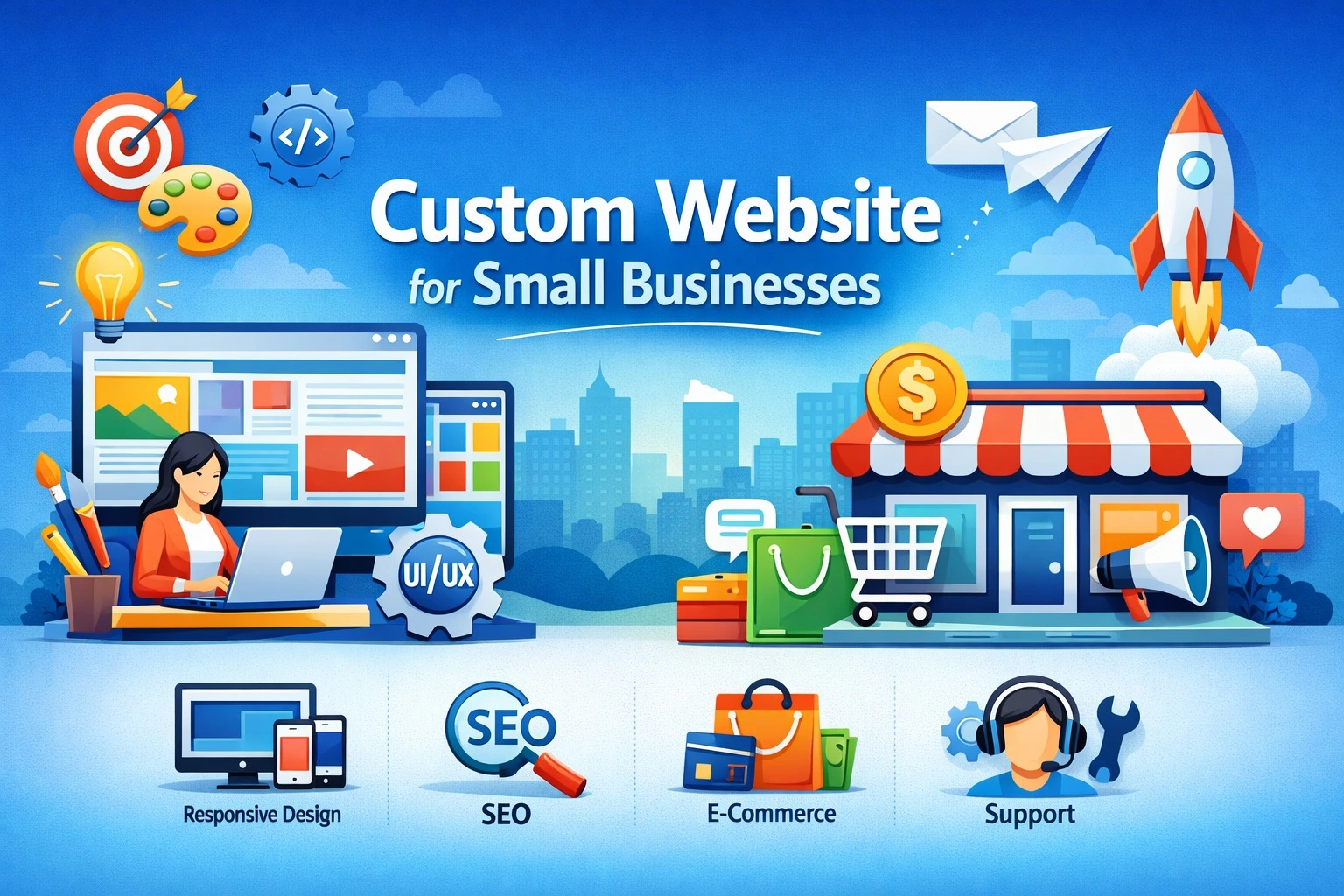
A custom website is built from scratch specifically for your business, tailored to your brand identity, goals, and target audience. Unlike template sites, which reuse generic layouts, custom sites give you full control over design, functionality, user experience, and scalability.
Why Small Businesses Should Strongly Consider a Custom Website
1. Stand Out with Unique Brand Identity
Your brand’s value depends on how people perceive it. Custom sites reflect your business personality through tailored visuals, messaging, and interactions that templates simply can’t match. This unique branding builds credibility and trust with visitors.
2. Better User Experience = Higher Conversions
Custom sites are designed around your audience’s behavior. That means clearer navigation, strategically placed calls-to-action, and faster load times all proven to increase conversions. One study notes that template sites can reduce conversion rates by up to 45% compared to custom solutions that match user expectations.
3. SEO & Search Visibility
Search engines reward sites that load fast, perform well, and deliver great experiences. Custom sites are built with clean code and SEO best practices from the start, helping you rank higher for keywords your customers actually search. Templates, on the other hand, can come with bloated code and limited SEO flexibility, hurting your organic reach.
4. Scalability and Flexibility
As your business grows, your website must keep up. Custom websites allow you to easily add features such as e-commerce, booking systems, or CRM integrations without major overhauls. Template sites often hit limitations and may require expensive workarounds later.
5. Long-Term Cost Efficiency
While templates seem cheaper at first, they often incur recurring fees, plugins, and redesign costs that accumulate. A custom website is a one-time investment that becomes a business asset increasing traffic, leads, and sales over time.
Custom vs Template Website Comparison
| Factor | Template Website | Custom Website |
| Initial Cost | Low (₹15,000–₹40,000 approx.) | Higher (40,000–₹1,00,000+ approx.) |
| Design Flexibility | Limited | Fully tailored |
| Branding | Generic | Unique |
| Scalability | Restricted | Easy expansion |
| SEO & Speed | Template dependent | Built-in optimised |
| Conversion Potential | Medium | High |
| Long-Term ROI | Medium | High |
| Integration | Limited | Seamless |
Real Case Study: Local E-Commerce Business
Business Name: Ajay’s Handcrafted Decor
Industry: Home decor e commerce
Business Type: Small local retailer expanding online
Ajay’s Handcrafted Decor specialized in handcrafted home decoration products and relied mainly on social media promotions and repeat customers. Although the company had an online store, the website functioned more as a product catalog than a strong sales channel. Management noticed that website traffic was not translating into consistent online revenue.
Situation Before the Custom Website
The business operated on a template based e commerce platform. While the website allowed products to be displayed online, it lacked performance optimization and conversion focused design.
Key limitations of the previous website
| Area | Issues Identified | Business Impact |
|---|---|---|
| Website Speed | Slow loading product and category pages | Visitors left before browsing products |
| Product Display | Limited layout flexibility and poor visual hierarchy | Products did not stand out or encourage exploration |
| Navigation | Basic menu structure without smart filters | Customers struggled to find specific items |
| Checkout Process | Multiple steps with unnecessary form fields | High cart abandonment rate |
| Mobile Experience | Layout not fully optimized for mobile devices | Poor usability for majority of users |
| Backend Integration | No connection with inventory system | Manual stock updates and order errors |
As a result, marketing campaigns generated visits, but the website failed to convert those visitors into paying customers.
Custom Website Implementation
The company invested in a fully custom e commerce website designed around user behavior, brand positioning, and long term scalability.
Major improvements introduced
| Improvement Area | Custom Solution Implemented | Purpose |
|---|---|---|
| Homepage Strategy | Dynamic homepage highlighting best selling and seasonal products | Guide visitors toward high demand items |
| Speed Optimization | Image compression, code optimization, and improved hosting setup | Reduce load time and prevent early exits |
| Smart Product Filters | Filters by price, category, material, and style | Help users quickly find relevant products |
| Checkout Simplification | Streamlined two step checkout with guest option | Reduce friction and improve completion rate |
| Mobile First Design | Responsive layout designed primarily for mobile users | Improve usability on smartphones |
| System Integration | Inventory management system linked with website | Real time stock updates and smoother operations |
Performance Results After Six Months
Within six months of launching the custom website, the business recorded measurable improvements across key performance indicators.
| Metric | Before Custom Website | After Custom Website | Growth |
|---|---|---|---|
| Conversion Rate | Baseline | Increased by 38 percent | Significant improvement in sales efficiency |
| Organic Traffic | Baseline | Increased by 45 percent | Better visibility in search engines |
| Average Order Value | Baseline | Increased by 22 percent | Customers purchased more per transaction |
Impact on Customer Behavior
The improved design and functionality changed how users interacted with the website.
| Customer Behavior Metric | Before | After |
|---|---|---|
| Ease of Product Discovery | Limited due to poor filters | Improved with personalized filters |
| Checkout Completion | Frequent drop offs | Smoother process with fewer steps |
| Mobile Shopping Experience | Inconsistent and difficult | Seamless and user friendly |
| Repeat Purchases | Occasional | Noticeable increase due to better experience |
Customers found it easier to browse, compare, and purchase products, which directly influenced both first time and repeat sales.
Business Outcomes Beyond Sales
The custom website also delivered operational and strategic benefits.
- Inventory accuracy improved due to system integration
- Customer support queries reduced because product information became clearer
- Marketing campaigns achieved better return on investment because more visitors converted
- The brand image strengthened, positioning the business as a premium handcrafted decor provider
Ajay, the business owner, reported that the website evolved from being a simple online presence into a primary revenue generating channel. The improved user experience not only attracted more first time buyers but also encouraged repeat customers, creating a stable growth cycle.
FAQs
Q1: Custom websites cost too much upfront. Is it really worth it?
A: Yes , while the upfront cost is higher, custom websites deliver higher conversions, better SEO, and reduced recurring redesign costs, resulting in better ROI over time. Templates may seem cheaper initially but can limit growth and profitability in the long run.
Q2: We’re a small local business do we really need custom design?
A: Absolutely. Local businesses benefit greatly from a professional website that ranks well in search engines, converts visitors into customers, and builds credibility all of which a custom site does better than templates.
Q3: What about maintenance , is it difficult?
A: Custom sites do require updates and occasional professional support, but that’s true for any quality website. Many agencies provide maintenance packages that keep sites secure and up-to-date.
Q4: What if we need new features later?
A: That’s one of the biggest advantages of custom websites they’re built to scale. Adding e-commerce functionality, customer portals, or advanced marketing tools is far easier with a custom site than a template.
Conclusion
A custom website is more than a visual upgrade it’s an investment in your business growth. It offers credible branding, improved user experience, better SEO, and scalability that templates struggle to deliver. For small businesses looking to attract more customers, increase conversions, and compete effectively online, a custom website isn’t just worth it it’s a strategic necessity.
For small businesses aiming to attract more customers, improve conversions, and build a strong competitive presence online, a custom website becomes a strategic investment rather than an optional expense. It supports marketing performance, strengthens brand positioning, and creates a foundation that can evolve alongside your business goals.
Businesses that want a website designed not only for appearance but also for performance and growth often choose to work with experienced web development partners such as Pointer Soft Technologies, who focus on building scalable, conversion oriented digital platforms tailored to business objectives.