Selling high-ticket services is completely different from selling low-cost products. When clients invest ₹1 lakh, ₹5 lakh, or more into a service, they don’t make impulsive decisions. They evaluate trust, authority, expertise, and brand positioning before contacting you. Your website design directly influences whether premium clients see you as an expert or just another service provider. This guide explains how to design a high-ticket service website that attracts premium clients and maximizes conversions.
What Is a High-Ticket Service Website?
A high-ticket service website promotes premium services such as:
- Business consulting
- IT & software services
- Marketing agencies
- Legal services
- Luxury interior design
- Financial advisory
These websites focus more on authority and trust than on discounts or flashy visuals. High-ticket clients make calculated decisions, not emotional impulse purchases. When someone plans to invest a significant amount in a service, they evaluate expertise, credibility, stability, and long-term value before they even think about pricing. Your website must demonstrate that you understand complex problems, have solved them successfully, and can deliver measurable outcomes. Strong case studies, real client testimonials, clear processes, and confident messaging build reassurance. Clean layouts, professional branding, and structured information communicate maturity and reliability. Flashy animations or discount-driven messaging may attract attention, but authority earns respect. In high-ticket services, respect converts better than hype.
Why Most Service Websites Fail to Attract Premium Clients
Many businesses invest in websites but fail to attract high-paying clients because they:
1. Use generic templates
Generic templates follow the same structure for every industry. They do not reflect your brand’s uniqueness or strategic positioning. High-ticket clients expect a customized experience. When your website looks like dozens of others, it reduces perceived value and weakens brand differentiation.
2. Focus Only on Design, Not Positioning
A visually attractive website alone does not generate premium leads. Positioning defines who you serve, what specific problem you solve, and why you are different. If your website fails to communicate this clearly, visitors get confused. Confused visitors do not convert.
3. Lack Authority Signals
Authority signals such as case studies, testimonials, certifications, awards, and measurable results build credibility. Without proof, your website sounds like it is making claims without evidence. High-ticket clients look for demonstrated expertise before making contact.
4. Provide Unclear Value Propositions
An unclear value proposition confuses visitors and weakens your ability to attract premium clients. When your website uses vague statements like “We Provide Quality Services” or “We Deliver Excellence,” it fails to communicate what you actually do, who you help, and what specific results you generate. High-ticket buyers do not have time to interpret generic messaging. They want immediate clarity. A strong value proposition clearly defines your target audience, the core problem you solve, and the measurable outcome clients can expect. When this clarity is missing, visitors hesitate, lose interest, or assume you are not specialized enough for their needs. Clear positioning builds confidence, while vague messaging creates doubt. In high-ticket services, doubt kills conversions.
5. Use Weak CTAs
Weak calls-to-action reduce conversion potential because they fail to guide visitors toward a meaningful next step. Generic buttons like “Submit,” “Click Here,” or “Learn More” do not communicate value or urgency. High-ticket clients need clarity about what will happen after they take action. A strong CTA should feel purposeful and benefit-driven, such as “Book a Strategy Call,” “Request a Custom Proposal,” or “Schedule a Consultation.” These phrases clearly indicate the outcome and align with premium positioning. Weak CTAs create hesitation because they lack direction and emotional motivation.
6. Ignore User Psychology
High-ticket buyers think carefully before investing. They evaluate risk, credibility, and long-term value. If your website does not reduce uncertainty and build reassurance, prospects hesitate. Strategic design must consider trust, clarity, simplicity, and confidence to influence decisions effectively.
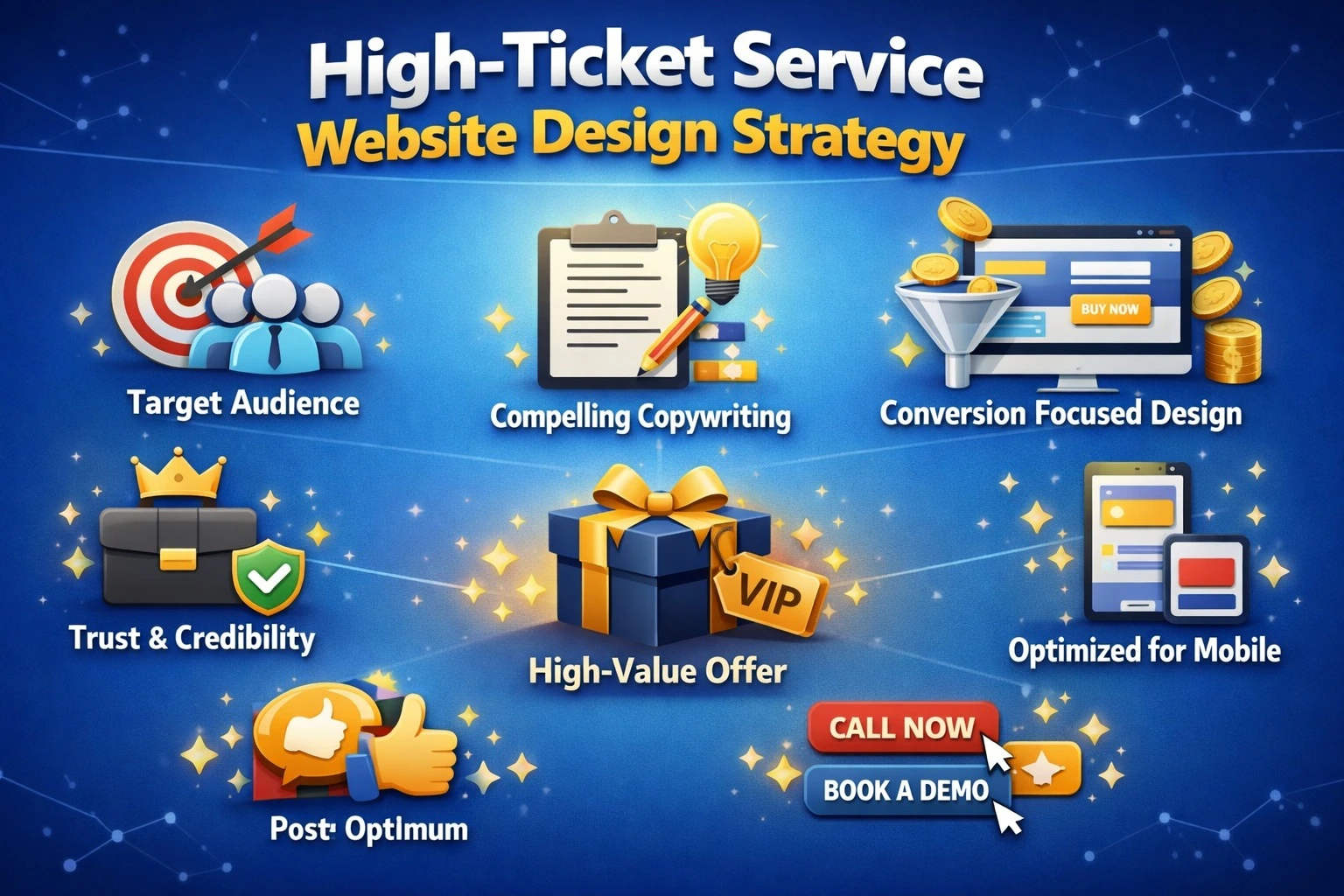
Core Website Design Strategy for High-Ticket Services
1. Strong Above-the-Fold Positioning
Strong above-the-fold positioning determines whether a premium visitor stays on your website or leaves within seconds. The “above-the-fold” section is the first visible area of your homepage before users scroll. This space must immediately communicate who you serve, what specific problem you solve, and what outcome clients can expect. High-ticket buyers do not have time to decode vague messaging. They scan quickly and decide whether your expertise matches their needs. A powerful headline, a clear subheading, and a strategic call-to-action should work together to establish authority and direction. Instead of generic statements, use outcome-driven language that reflects specialization and confidence.
2. Authority-Driven Website Structure
An authority-driven website structure is designed to build trust, credibility, and expertise in the minds of visitors from the moment they land on the page. Instead of focusing only on visuals, this structure highlights strong proof elements such as case studies, client testimonials, certifications, industry experience, portfolio samples, and clear service processes. It organizes content in a way that answers user doubts step by step who you are, what you do, why you are qualified, and how you deliver results. By placing trust signals strategically (like results, client logos, reviews, and detailed service explanations), the website reduces hesitation and increases conversion potential. This kind of structure not only improves user confidence but also strengthens brand positioning and supports better long-term SEO performance.
3. Conversion-Focused Service Pages
Conversion-focused service pages do more than describe what you offer they strategically guide visitors toward taking action. High-ticket clients evaluate services carefully, so your service page must address their specific problems, demonstrate your expertise, and clearly explain the transformation you provide. Instead of listing features, focus on outcomes and measurable results. Start with a strong problem statement that reflects the client’s pain points, then present your solution framework in a structured and confident manner. Include proof elements such as case studies, testimonials, data points, or real examples to build credibility. Break content into clear sections with logical flow so readers can scan easily.
4. Social Proof & Case Studies
Social Proof & Case Studies play a critical role in building trust and influencing buying decisions on a website. Social proof includes elements like client testimonials, Google reviews, ratings, client logos, media mentions, and real feedback that show others have already trusted and benefited from your services. It reduces doubt and increases credibility instantly.
Case studies go one step deeper. Instead of just saying “we deliver results,” they demonstrate how you delivered those results. A strong case study explains the client’s problem, your strategy, the execution process, and measurable outcomes such as increased traffic, higher conversions, or revenue growth. This storytelling format helps potential clients visualize what you can achieve for them.
5. Premium Visual Branding
Premium visual branding shapes how high-ticket clients perceive your business within seconds. When visitors land on your website, they subconsciously judge your professionalism, credibility, and pricing level based on visual presentation. A premium brand does not rely on loud colors, cluttered layouts, or excessive animations. Instead, it communicates confidence through clean design, strategic white space, refined typography, high-quality imagery, and consistent color schemes.
Strong visual hierarchy guides attention smoothly from headline to supporting content to call-to-action. Professional photography, authentic team images, and polished graphics reinforce legitimacy. Consistency across pages builds familiarity and trust, while minimal clutter signals clarity and control. Premium branding makes your services feel valuable before prospects even read the details.
Real Case Study: IT Consulting Company
Client:
Mid-sized IT consulting firm targeting enterprise clients.
Problem:
- Website looked outdated
- Generic messaging
- No case studies
- Conversion rate below 1%
- Mostly low-budget inquiries
Strategy Implemented:
- Repositioned homepage with niche-focused headline
- Added 5 detailed case studies
- Created separate pages for enterprise services
- Redesigned layout with premium branding
- Added strategy call booking CTA
- Optimized page speed
Results After 90 Days
| Metric | Before Redesign | After Redesign |
| Monthly Website Visitors | 4,200 | 4,500 |
| Conversion Rate | 0.9% | 3.8% |
| Qualified Leads per Month | 38 | 171 |
| Average Deal Size | ₹1.2 Lakh | ₹3.8 Lakh |
| Low-Quality Inquiries | High | Very Low |
| Bounce Rate | 68% | 41% |
Key Insight:
Traffic increased only slightly. But conversion rate improved significantly because positioning, trust signals, and authority increased. This shows that design strategy impacts revenue more than traffic alone.
Psychology Behind Premium Client Conversion
1. Expertise
Clients want to feel that they are dealing with specialists, not generalists. Expertise is demonstrated through in-depth content, clear service explanations, industry-specific knowledge, technical understanding (like UX, SEO structure, speed optimization), and real examples of past work. When a website explains problems in detail and provides practical solutions, it signals experience. Portfolio samples, certifications, detailed case studies, and niche-focused services all strengthen the perception of expertise. Without this, a business appears ordinary and easily replaceable.
2. Confidence
Confidence is reflected in how clearly and boldly a company presents itself. Weak language like “we try” or “we aim to” reduces trust. Strong positioning statements, clear value propositions, and result-driven messaging show authority. Confident websites communicate outcomes, not just services. They avoid hesitation in their tone and provide decisive calls-to-action. When a brand appears confident in its abilities, visitors feel more secure choosing it.
3. Clarity
Confusion kills conversions. Clients look for simple, structured, and easy-to-understand communication. They want to know exactly what you offer, who it is for, how it works, what it costs (at least broadly), and what results they can expect. Clear headings, structured sections, bullet points, FAQs, and step-by-step process explanations improve clarity. If visitors have to guess what you do, they will leave. Clarity reduces friction and builds trust quickly.
4. Reputation
Reputation answers the question: “Can I trust them?” Social proof elements such as testimonials, client logos, Google reviews, ratings, awards, and partnerships help establish credibility. Online presence, consistent branding, and positive client feedback strengthen perception. Even subtle signals like professional design, updated content, and visible contact details contribute to reputation. A strong reputation lowers perceived risk for the client.
5. Process Transparency
Clients are often afraid of the unknown delays, hidden costs, poor communication. Process transparency removes that fear. Clearly explaining your workflow
Clients want to feel that they are dealing with specialists, not generalists. Expertise is demonstrated through in-depth content, clear service explanations, industry-specific knowledge, technical understanding (like UX, SEO structure, speed optimization), and real examples of past work. When a website explains problems in detail and provides practical solutions, it signals experience. Portfolio samples, certifications, detailed case studies, and niche-focused services all strengthen the perception of expertise. Without this, a business appears ordinary and easily replaceable.
2. Confidence
Confidence is reflected in how clearly and boldly a company presents itself. Weak language like “we try” or “we aim to” reduces trust. Strong positioning statements, clear value propositions, and result-driven messaging show authority. Confident websites communicate outcomes, not just services. They avoid hesitation in their tone and provide decisive calls-to-action. When a brand appears confident in its abilities, visitors feel more secure choosing it.
3. Clarity
Confusion kills conversions. Clients look for simple, structured, and easy-to-understand communication. They want to know exactly what you offer, who it is for, how it works, what it costs (at least broadly), and what results they can expect. Clear headings, structured sections, bullet points, FAQs, and step-by-step process explanations improve clarity. If visitors have to guess what you do, they will leave. Clarity reduces friction and builds trust quickly.
4. Reputation
Reputation answers the question: “Can I trust them?” Social proof elements such as testimonials, client logos, Google reviews, ratings, awards, and partnerships help establish credibility. Online presence, consistent branding, and positive client feedback strengthen perception. Even subtle signals like professional design, updated content, and visible contact details contribute to reputation. A strong reputation lowers perceived risk for the client.
5. Process Transparency
Clients are often afraid of the unknown — delays, hidden costs, poor communication. Process transparency removes that fear. Clearly explaining your workflow (consultation → planning → design → development → testing → launch → support) gives clients visibility into how their project will be handled. When timelines, deliverables, revision policies, and communication steps are clearly mentioned, it creates predictability. Transparency builds long-term trust and positions your company as organized and reliable. gives clients visibility into how their project will be handled. When timelines, deliverables, revision policies, and communication steps are clearly mentioned, it creates predictability. Transparency builds long-term trust and positions your company as organized and reliable.
Checklist Before Launching a High-Ticket Website
1. Clear Niche Positioning
Your website should clearly define who you serve and what specific problem you solve. Instead of saying “we design websites,” specify something like “we design high-converting eCommerce websites for growing Indian brands.” A clear niche makes your business more memorable and trustworthy, and it reduces confusion for visitors.
2. Outcome-Driven Headline
Your main headline should focus on results, not just services. Instead of “Website Designing Services,” say “Websites That Generate Qualified Leads for Your Business.” Outcome-driven headlines immediately communicate value and capture attention because clients care about results, not technical processes.
3. At Least 3 Case Studies
Case studies provide proof that your work delivers measurable results. Having at least three detailed examples shows consistency and reliability. They should explain the client’s problem, your approach, and the outcomes (traffic growth, revenue increase, conversion boost). This reduces risk perception for new clients.
4. Strong Testimonials
Testimonials build emotional trust. Real client feedback with names, company details, or photos feels authentic and credible. Specific testimonials that mention results or positive experiences are far more powerful than generic praise like “great service.”
5. Professional Photography
High-quality images of your team, office, or real projects increase credibility. Professional visuals signal seriousness and investment in your brand. Poor or generic stock images can weaken authority and reduce trust.
6. Structured Service Pages
Each service page should follow a logical and persuasive flow that mirrors how buyers make decisions. Start by clearly defining the problem your target audience is facing so they immediately feel understood. Then present your solution, explaining how your service directly addresses that problem in a specific and structured way. Next, outline your process, showing step-by-step how you deliver results. This builds transparency and reduces uncertainty. After that, highlight the benefits, focusing on outcomes rather than just features. Support these claims with proof such as case studies, testimonials, data, or certifications to build credibility and trust. Finally, end with a strong, clear CTA that tells users exactly what to do next.
7. Clear CTAs (Call-to-Actions)
Clear calls-to-action guide visitors toward the exact next step you want them to take. High-ticket clients do not respond to vague buttons; they respond to confident, outcome-driven actions. A clear CTA communicates both the action and the benefit, such as “Book a Strategy Call” or “Request a Custom Proposal.” It removes confusion, reduces hesitation, and makes the decision process easier. When CTAs are specific, visible, and strategically placed throughout the page, they improve user flow and significantly increase conversion rates.
Frequently Asked Questions (FAQ)
1. What makes a website suitable for high-ticket services?
A high-ticket website focuses on authority, case studies, clear positioning, premium branding, and structured service pages. It builds trust before asking for a sale.
2. How many case studies should a high-ticket website have?
At least 3–5 detailed case studies with measurable results improve credibility significantly.
3. Does website design really impact high-ticket sales?
Yes. Premium clients judge expertise within seconds. A weak design reduces trust and lowers conversion rates.
4. Should high-ticket websites display pricing?
It depends on your strategy. Many high-ticket services avoid fixed pricing and instead encourage consultation calls.
5. How important is website speed for premium clients?
Very important. Slow websites create doubt and reduce perceived professionalism.
Final Thought
High-ticket service websites are not built to impress they are built to position. Design alone may attract attention, but strategy is what attracts commitment. When a website is structured around authority, clarity, and buyer psychology, it naturally filters out price-sensitive inquiries and appeals to serious decision-makers. Every element from the headline to the case studies and CTAs should reinforce expertise, confidence, and measurable results.
Premium clients do not choose based on low pricing; they choose based on trust, capability, and predictability. A strategically structured website communicates value before cost is even discussed. It addresses objections, highlights process transparency, and showcases proven outcomes.This is the philosophy followed by Pointer Soft Technologies focusing on authority-driven structure, conversion-focused design, and long-term brand positioning rather than just visual appeal. The goal is simple: build websites that act as growth assets, not just online brochures.