Many businesses invest in a new website expecting instant visibility on Google only to discover months later that traffic is stagnant and enquiries are minimal. In most cases, the issue is not SEO done later, but SEO mistakes made during website development itself. Search engines evaluate structure, performance, and usability from the very beginning. If your website is built incorrectly, rankings suffer before SEO efforts even begin.
Understanding these common website development mistakes can help you avoid long-term SEO damage and build a site that supports growth from day one.
1. Ignoring SEO During the Development Phase
One of the biggest mistakes businesses make is treating SEO as a post-launch activity. When SEO is not considered during development, critical elements like site structure, URL hierarchy, internal linking, and crawl ability are often overlooked. Search engines rely on clean architecture to understand your website. If developers focus only on design and functionality, SEO becomes an expensive fix later rather than a built-in advantage.
2. Poor Website Structure and Navigation
A confusing website structure makes it difficult for both users and search engines to navigate your content. Pages buried too deep in the hierarchy may not get indexed properly, reducing their ranking potential. Clear navigation, logical page grouping, and a flat site structure help search engines crawl your website efficiently and improve user experience both essential SEO factors.
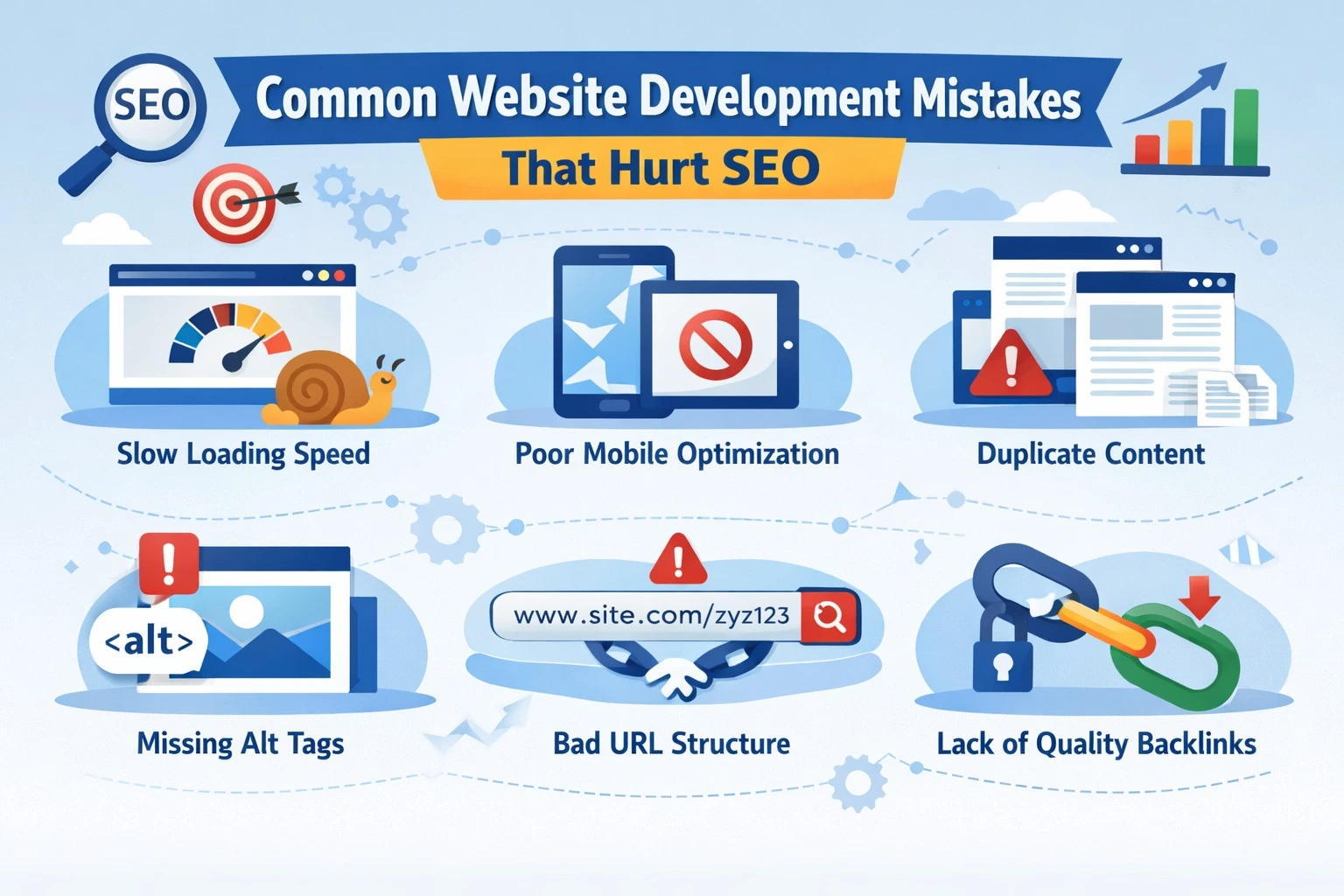
3. Slow Page Speed and Heavy Code
Website speed is a direct ranking factor. Poorly optimized code, oversized images, unnecessary scripts, and heavy animations can slow your site significantly. Slow websites increase bounce rates, reduce dwell time, and send negative signals to search engines. Performance optimization should be part of development, not an afterthought.
4. Mobile-Unfriendly Development
Google uses mobile-first indexing, meaning it primarily evaluates the mobile version of your website for ranking. Websites developed only with desktop users in mind often fail on mobile devices. Responsive design, touch-friendly navigation, and fast mobile load times are essential to avoid SEO penalties and user drop-offs.
5. Missing or Improper On-Page SEO Elements
Many websites launch without optimized title tags, meta descriptions, header hierarchy (H1–H3), or image alt text. These elements help search engines understand what your pages are about. Without them, even well-designed websites struggle to rank for relevant keywords.
6. Duplicate Content and Poor URL Handling
Improper URL structures, missing canonical tags, or duplicate versions of the same page (HTTP/HTTPS, www/non-www) confuse search engines and dilute ranking signals. Clean URLs and correct canonical implementation are foundational SEO requirements during development.
7. Lack of Internal Linking
Internal linking helps distribute authority across your website and guides users toward important pages. Many developers overlook internal linking, resulting in orphan pages that never rank. Strategic internal links improve crawlability, page authority, and conversion paths.
8. Ignoring Technical SEO Basics
Technical SEO errors such as missing XML sitemaps, incorrect robots.txt files, broken links, or improper redirects can block search engines from accessing your content. These mistakes silently hurt SEO and often go unnoticed until traffic drops.
9. No Focus on User Experience (UX)
Search engines increasingly prioritize user behavior signals such as bounce rate, session duration, and engagement. A website that looks good but frustrates users with poor layout, unclear CTAs, or cluttered design will struggle to rank. SEO and UX are deeply connected—bad user experience weakens SEO performance.
Common Mistakes vs SEO Impact
| Website Development Mistake | SEO Impact |
| Slow page loading speed | Lower rankings, higher bounce rate |
| Poor site structure | Crawl issues, weak indexation |
| Non-responsive design | Mobile ranking loss |
| Missing meta tags | Reduced click-through rates |
| Duplicate URLs | Keyword cannibalization |
| No internal linking | Weak page authority |
| Heavy JavaScript without optimization | Indexing issues |
| Missing sitemap | Poor crawl coverage |
Case Study: How a Poorly Built Website Hurt SEO
A Delhi NCR-based service business approached us after struggling with low website traffic despite investing in SEO for six months. Upon auditing their website, we found multiple development-level SEO issues:
- Slow page load time (over 6 seconds)
- No clear H1 structure
- Duplicate service pages with different URLs
- Broken internal links
- No mobile optimization
Instead of continuing SEO blindly, we rebuilt the website with SEO-friendly development practices—clean code, improved structure, optimized speed, and proper internal linking. Within three months of relaunch, organic traffic increased by 68%, and enquiry submissions nearly doubled.
This case highlights how SEO success depends heavily on how a website is developed, not just on keywords or backlinks.
Why SEO Friendly Development Matters
SEO is not a plugin you install or a one-time task you complete after a website goes live. It is the outcome of hundreds of technical, structural, and usability decisions made during the website development process. From site architecture and page speed to mobile responsiveness, clean code, and internal linking, every development choice directly impacts how search engines crawl, index, and rank your website. When these elements are ignored or implemented incorrectly, SEO performance suffers long before optimization efforts even begin.
Fixing development-level SEO mistakes after launch often costs significantly more time, money, and lost business opportunities than building the website correctly from the start. Poor structure, slow performance, or technical errors can delay rankings, reduce visibility, and limit lead generation, forcing businesses to spend extra resources on rework instead of growth.
A well-built, SEO-friendly website provides a strong foundation for long-term digital success. It allows search engines to understand your content easily, improves rankings faster, enhances user experience, and delivers a higher return on investment by converting organic traffic into real enquiries and sales..
Frequently Asked Questions (FAQs)
1. Can SEO be fixed after a website is developed?
Yes, but fixing development-level SEO issues later is more expensive and time-consuming than building it right initially.
2. Does website speed really affect SEO?
Absolutely. Page speed is a confirmed ranking factor and strongly affects user engagement.
3. Is mobile optimization necessary for SEO?
Yes. Google uses mobile-first indexing, making mobile optimization essential.
4. Do developers need to understand SEO?
At least basic SEO principles are crucial for developers to avoid structural mistakes.
5. How important is internal linking for SEO?
Internal linking improves crawlability, authority flow, and user navigation.
6. Can design choices impact SEO?
Yes. Poor UX, heavy graphics, and unclear layouts negatively affect SEO signals.
7. What is technical SEO in development?
It includes site speed, crawlability, indexing, structured data, and clean code.
8. Should SEO be planned before development starts?
Ideally, yes. SEO planning during development saves cost and improves results.
9. How long does it take to recover from SEO mistakes?
Depending on severity, recovery can take weeks to months after fixes are implemented.
Final Takeaway
Most SEO failures don’t start with keywords they begin with poor website development decisions. Avoiding these common website development mistakes ensures your website is search-engine-friendly from day one, helping you rank faster, attract qualified traffic, and convert visitors into customers. This is why experienced development teams like Pointer Soft Technologies focus on building websites with SEO, performance, and user experience aligned from the very start.