A slow website quietly damages lead generation, search visibility, and brand trust. Most users decide within seconds whether to stay or leave, and when a website loads slowly or feels unresponsive, potential customers exit without taking action. Many businesses lose valuable enquiries every day without realizing that website performance is the real problem.
This raises a critical question for growing businesses. Is poor website performance caused by frontend design or backend development?
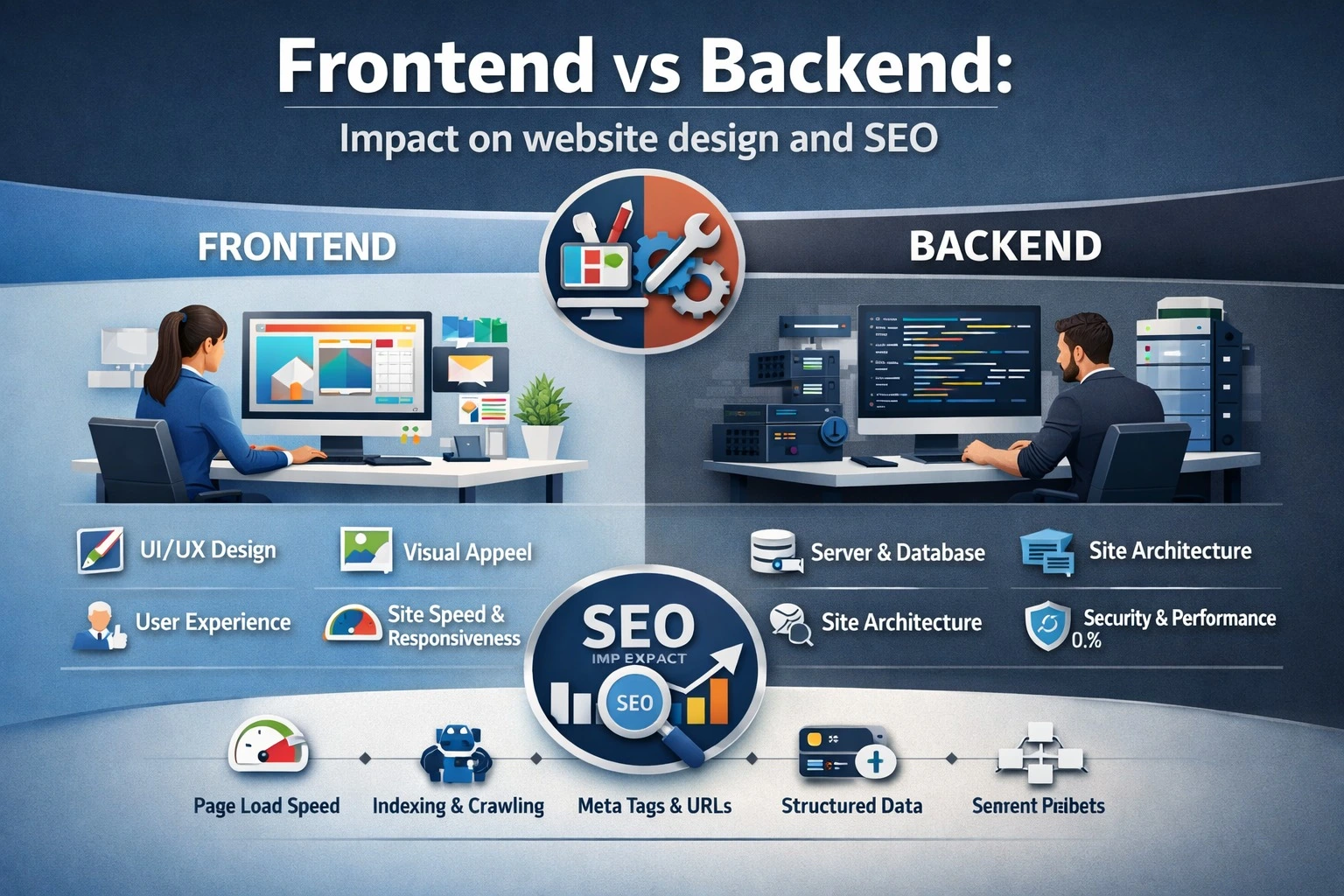
The answer is not straightforward. Both frontend and backend influence website speed, SEO performance, and conversion rates, but their impact differs significantly. Fixing the wrong area first often results in wasted effort and delayed results.
This blog explains what truly affects website speed, how frontend and backend performance shape SEO and conversions, and where businesses should focus first to drive measurable and sustainable growth through balanced website optimization.
Website Speed: Who Impacts It More?
Website speed begins at the frontend. Heavy images, unoptimized CSS, excessive JavaScript, and poor layout structure slow down the first contentful paint and largest contentful paint, both critical Core Web Vitals.
However, backend delays appear after the initial load. Slow servers, inefficient database queries, and poor API response time increase time to first byte (TTFB) and break dynamic functionality.
In most business websites, frontend issues cause 60–70% of perceived slowness, while backend problems account for the remaining delay, especially on data-heavy platforms.
Speed Impact Comparison
| Performance Factor | Frontend Impact | Backend Impact |
| Initial page load | Very High | Medium |
| User-perceived speed | Very High | Low |
| Dynamic content loading | Medium | High |
| Mobile performance | Very High | Medium |
| Core Web Vitals | High | Medium |
SEO Impact: Frontend Takes the Lead
Search engines measure how users experience your website. That puts frontend performance at the center of SEO success.
Mobile responsiveness
Mobile responsiveness ensures that a website adapts smoothly to different screen sizes and devices. When users struggle to read content or interact with buttons on mobile, they leave immediately. Search engines also prioritize mobile friendly websites, making responsiveness essential for both user experience and SEO.
Page speed
Page speed determines how quickly content appears on the screen. Slow loading pages frustrate users and increase bounce rates, directly reducing conversions. Faster websites improve engagement, help retain visitors, and perform better in search rankings.
Layout stability
Layout stability refers to how consistently elements stay in place while a page loads. When content shifts unexpectedly, users lose trust and often click the wrong elements. Stable layouts create a smoother experience and are a key factor in Google’s Core Web Vitals.
Accessibility
Accessibility ensures that all users, including those with disabilities, can navigate and understand your website. Clear contrast, readable text, keyboard navigation, and proper labels improve usability for everyone. Accessible websites also perform better in search results and build stronger brand credibility.
Clean HTML structure
Clean HTML structure helps browsers and search engines understand your content easily. Well organized markup improves page loading, supports better SEO indexing, and makes future updates faster and more cost effective. Clean code also reduces technical issues that can impact performance and usability.
All of these belong primarily to frontend implementation. Backend matters when poor server response causes crawl issues, downtime, or broken URLs. But for most businesses, SEO losses happen because of frontend neglect, not backend complexity.
If your website looks good but ranks poorly, frontend code structure, loading behavior, and UX signals are usually the reason.
Conversions: Where Design Meets Logic
Conversions depend on trust, clarity, and ease of action. Frontend design directly influences all three. Users decide within seconds whether to fill a form, click a button, or exit. Backend supports conversions by ensuring forms submit correctly, pages do not crash, and data processes smoothly. But backend rarely creates conversions, it only prevents failures.
In real business scenarios, frontend improvements increase conversions faster than backend upgrades, unless the backend is fundamentally broken.
Case Study: How Frontend Optimization Improved Website Performance and Conversions
A Delhi based service company contacted a web agency after experiencing low enquiry volumes despite consistent website traffic. Although users were visiting the site regularly, very few were converting into leads. A performance audit revealed that the issue was not traffic quality, but poor website experience.
Initial Challenges
The website performed poorly on mobile devices and failed key Core Web Vitals benchmarks. Large image files, unoptimized scripts, and an unclear layout hierarchy slowed down page loading and confused users. The backend ran on standard PHP hosting and showed no major technical limitations, indicating that frontend performance was the primary concern.
Optimization Strategy
The agency focused on frontend optimization to improve speed, usability, and conversion flow. The team compressed and optimized images, implemented lazy loading, reduced unnecessary scripts, simplified the layout structure, and enhanced call to action visibility. Backend changes remained minimal since the server performance was stable.
Performance Results After 60 Days
| Metric | Before Optimization | After Optimization | Improvement |
|---|---|---|---|
| Page Load Time | 4.8 seconds | 1.9 seconds | 60 percent faster |
| Bounce Rate | High | Reduced | 38 percent drop |
| Organic Traffic | Baseline | Increased | 22 percent growth |
| Lead Conversions | Low | Improved | 41 percent increase |
Key Takeaway
This case study clearly demonstrates that frontend optimization can deliver immediate and measurable improvements in website speed, user engagement, and lead conversions. Without major backend changes, the business achieved better performance and higher enquiry rates by fixing frontend issues that directly impacted user experience.
When Backend Becomes the Bottleneck
While frontend optimization usually delivers faster improvements in website speed and conversions, backend performance becomes critical in specific business scenarios. Large ecommerce platforms, SaaS dashboards, booking portals, and data driven websites rely heavily on backend systems to process user actions, manage data, and deliver real time responses. In such environments, even minor backend inefficiencies can slow down the entire user experience.
Slow APIs increase waiting time when users load products, submit forms, or complete transactions. Poorly indexed databases struggle to handle growing data volumes, leading to delays, errors, or timeouts. Weak server configuration and inadequate resource allocation further amplify these problems, especially during traffic spikes. In these cases, a visually optimized frontend cannot compensate for backend delays, and users still perceive the website as slow or unreliable.
Backend limitations often surface when businesses begin to scale. As traffic increases, data grows, and user interactions become more complex, systems that once worked smoothly start showing performance cracks. Checkout failures, delayed confirmations, broken dashboards, and inconsistent page responses directly impact trust and revenue.
Frontend vs Backend: What Should Businesses Prioritize First?
For most small and mid sized businesses, frontend optimization delivers faster return on investment because it directly improves how users experience the website. Faster loading pages, better mobile responsiveness, stable layouts, and clearer call to actions immediately enhance website speed, strengthen SEO signals, and build user trust. These improvements often lead to higher engagement and more enquiries without requiring heavy technical changes.
Backend optimization becomes essential as the business grows and website usage increases. When traffic rises, data volumes expand, and user interactions become more complex, backend systems must support that demand without slowing down performance. Scalable backend architecture ensures reliability, security, and smooth functionality over time.
High performing websites do not treat frontend and backend as separate priorities. They align both with clear business goals, using frontend optimization to drive immediate results and backend optimization to support long term growth and stability.
Frequently Asked Question
Does frontend or backend affect website speed more?
Frontend affects perceived website speed more, especially during the initial page load. Backend impacts performance during dynamic interactions.
Can backend optimization improve SEO?
Yes, but indirectly. Backend helps SEO by improving server response time, uptime, and crawl efficiency, while frontend directly influences rankings.
Is frontend more important for conversions?
Yes. Frontend design controls user experience, trust signals, and call-to-action placement, which directly drive conversions.
Do I need backend optimization for a small business website?
Usually not immediately. A stable backend with frontend optimization works well for most small business websites.
How do I know where my website performance issue lies?
Performance audits using tools like PageSpeed Insights and real user behavior analysis reveal whether frontend or backend causes the problem.
Final Thoughts
Website performance is not a frontend vs backend battle. It is a strategic balance. Frontend design shapes user perception, SEO visibility, and conversion rates. Backend development ensures reliability, scalability, and long-term growth.
Businesses that focus only on visuals or only on technology lose opportunities. High-performing websites align design, speed, SEO, and functionality into one cohesive strategy.
At Pointer Soft Technologies, we design and develop websites with performance at the core—optimizing frontend for speed and conversions while building backend systems that scale with your business. If your website struggles to rank, load, or convert, the problem is rarely one-sided. The solution should not be either.